Quick Facts
- 📅 Race Date: Sunday 29 August 2027
- 📍 Start: Miller Street / St Leonards Park, North Sydney
- 🏁 Finish: Sydney Opera House Forecourt, Circular Quay
- 📏 Distance: 42.195 km (Full Marathon)
- 🌍 Race Status: Abbott World Marathon Major (7th Major) · World Athletics Platinum Label
- 👟 Field Size: ~40,000 runners · 140+ countries
- ⏱ Course Cut-Off: 7 hours from gun start
- 🎟 Registration: Public ballot opens 24 September 2026 · Closes 17 October 2026 (23-day window)
- 💰 Entry Fee: AUD $280 (AU/NZ residents) · AUD $330 (International)
- 🌡 Race Day Weather: 7–16°C (44–61°F) · Late winter, Sydney
- 🔗 Official Website: tcssydneymarathon.com
Why Sydney Is Already One of the Hardest Marathon Bibs in the World
The TCS Sydney Marathon only joined the Abbott World Marathon Majors in 2025, but it has compressed what took Tokyo and London decades to build into two editions. In 2025, the inaugural Major ballot drew 79,000 applications. In 2026 that jumped to 123,000. The field holds roughly 40,000 marathon places. The arithmetic is getting tighter every year and it will keep tightening.
What makes Sydney worth chasing is not just the Major stamp. It is the finish. Running across the Sydney Harbour Bridge in the opening kilometres and crossing the line on the forecourt of the Sydney Opera House is as good as urban marathon finishing gets. The course is not easy — 313 metres of cumulative elevation gain across a point-to-point route will punish anyone who mistakes the net-downhill profile for a fast day out — but it is spectacular from start to finish in a way that very few marathons in the world can match.
The 2026 edition confirmed that Sydney belongs at this level. Addisu Gobena ran a 2:04:42 course record, the top three men all finished inside 2:05, and Peres Jepchirchir won the women’s race to add another Major title to a career already stacked with them. Manuela Schär completed the historic first-ever sweep of all eight Abbott World Marathon Majors in the wheelchair race. This is a race that draws world-class fields and produces world-class racing.
For 2027 the race returns on Sunday 29 August. The public ballot opens on 24 September 2026 for just 23 days. If you are reading this and have not planned your entry yet, that window is the most important date on your running calendar right now.
2027 Sydney Marathon Registration and Entry
There are five legitimate routes into the 2027 TCS Sydney Marathon. The public ballot is the most accessible but not the most reliable. Here is a snapshot of each. For the full breakdown with real odds, honest costs and a step-by-step decision framework, read the Sydney Marathon 2027 complete entry guide.
| Entry Route | Guaranteed? | Cost | Best For |
|---|---|---|---|
| Public Ballot | No — draw only | AUD $280 (AU/NZ) · AUD $330 (International) — charged only if selected | Any runner willing to leave it to chance. Free to apply. No downside. |
| High Performance Program (HPP) | Yes | Standard entry fee only | Men sub-2:53 (18-34) or age-graded masters equivalent. AIMS-certified course required. |
| Charity Entry | Yes | AUD $3,000 fundraising minimum (not out-of-pocket — raised from your network) | Runners who missed the ballot, have a cause they care about and can mobilise a fundraising network. |
| Official Travel Partners | Yes | USD $1,300–$7,500 per person (excludes flights) | International runners who want bib and accommodation confirmed in one transaction. |
| Seven Rewards Newsletter | No — occasional giveaways only | Free | Everyone — sign up regardless of which other route you are pursuing. |
The full guide to every entry route — including honest odds, charity partner details and which route makes sense for your situation — is at the Sydney Marathon 2027 entry guide.
TCS Sydney Marathon 2027 — Race at a Glance
| Detail | Info |
|---|---|
| Race Date | Sunday 29 August 2027 |
| Race Edition | 27th edition · 3rd year as Abbott World Marathon Major |
| Start Location | Miller Street / St Leonards Park, North Sydney |
| Finish Location | Sydney Opera House Forecourt, Circular Quay |
| Distance | 42.195 km (Full Marathon) |
| Race Status | Abbott World Marathon Major (7th Major) · World Athletics Platinum Label |
| Field Size | ~40,000 marathon runners · 140+ countries |
| Course Type | Point-to-point · Net downhill (-83m net) · Cumulative gain +313m |
| Course Cut-Off | 7 hours from gun start |
| Start Gate Closure | 8:40 AM sharp · Late arrivals issued DNS, no exceptions |
| On-Course Fueling | Water and Powerade at KM 5, 10, 15, 20, 25, 30, 35, 40 · GU Energy Gels at KM 20 and KM 30 only |
| Entry Fee (AU/NZ) | AUD $280 · Non-refundable · Non-transferable |
| Entry Fee (International) | AUD $330 · Direct ballot or official travel partner |
| Race-Day Transport | 100% free public transport for registered runners — show your bib |
| Title Sponsors | TCS (Tata Consultancy Services) presented by ASICS |
| Official Website | tcssydneymarathon.com |
What Makes the TCS Sydney Marathon Worth Running
The finish line has no equal
The Sydney Marathon finishes on the forecourt of the Sydney Opera House with Sydney Harbour behind you. That is not marketing. When you turn off Macquarie Street in the final kilometre and the Harbour and the sails come into view, it is one of the most visceral finish-line moments in world running. London finishes on The Mall. New York finishes in Central Park. Sydney finishes at one of the most recognisable buildings on earth, on the water, with a crowd that treats the last 500 metres like a standing ovation. For pure visual drama at the line, it is unbeaten.
The Harbour Bridge opener sets the tone immediately
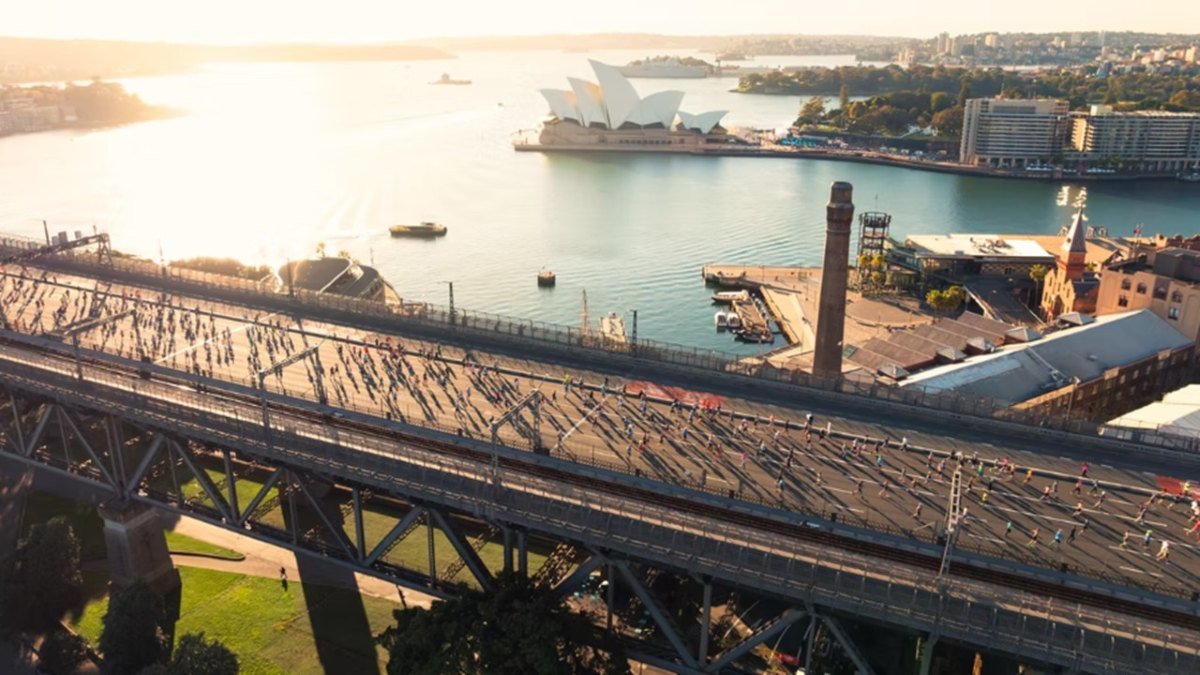
Within the first three kilometres you run across the Sydney Harbour Bridge. That is your welcome to the course — one of the world’s great pieces of infrastructure, cleared of traffic, with 40,000 runners filling it. The view south to the CBD and the Opera House from the bridge deck is exactly what Sydney looks like in every photo you have ever seen. The difference is you are running across it at race pace, in the cold, at dawn, surrounded by people who trained for months for this exact moment.
The 7-hour cut-off is genuinely inclusive
Sydney’s 7-hour cut-off is one of the most welcoming time limits among the World Marathon Majors. For context, Tokyo cuts at 7 hours, Chicago at 6:30 and London at 8 hours depending on wave and year. Sydney’s is consistent, clearly communicated and runs from gun start. For runners targeting a first marathon finish rather than a time, or returning to the sport after a break, the 7-hour window is real. The course is hard but the door is wide.
It is the newest Major, which still matters for ballot odds
Sydney is in year three of its Major journey. Tokyo took years to reach 1-in-10 ballot odds. Sydney sits at roughly 1 in 3 to 1 in 4 right now — tighter than that in practice because charity and HPP places reduce the open public pool, but still the most accessible Major after Berlin. If you are building a Six Star collection, the strategic window to lock in Sydney is now, not in five years when 200,000 people are applying for the same 40,000 spots.
Free race-day public transport is a genuine logistical advantage
Registered runners travel free across Sydney’s entire train, Metro and bus network on race morning. Show your bib. That is it. No booking, no taxi queues, no surge-priced rideshare. For a race that closes most of the CBD and inner North Shore to traffic and starts north of the bridge, this matters far more than it sounds. The Metro runs to Victoria Cross station (12-minute walk to the start) and Crows Nest station (18-minute walk). Getting to the start is stress-free if you pick the right station.
The course is hard in exactly the right way
The net downhill does not make Sydney fast. The 313 metres of cumulative gain makes it one of the hilliest Majors. The Oxford Street climb from KM 34 to 40 sits at exactly the point where recreational runners are running on fumes. That difficulty is also what makes finishing feel earned. Sub-elite runners chasing times generally find Sydney 3-5 minutes slower than Berlin or Chicago on comparable fitness. If you are after a PB, account for the course. If you are after a landmark experience, the difficulty is part of what you signed up for.
The Sydney Marathon Course — Segment by Segment
- Type: Point-to-point (North Sydney to Opera House Forecourt)
- Net elevation: -83m (net downhill)
- Cumulative gain: +313m
- Surface: Road throughout
- Race-defining segment: Oxford Street climb, KM 34–40
- Iconic segment: Sydney Harbour Bridge, KM 0–3
- Double spectator spots: Taylor Square (KM 15.4 and 36.2) · Moore Park (KM 29.4 and 34.4)
KM 0–3: The Harbour Bridge
The race starts at Miller Street in St Leonards Park and immediately climbs onto the Sydney Harbour Bridge. The first three kilometres are uphill — not aggressively so, but enough that you need to sit on your planned pace and ignore what the adrenaline, the crowd and the view are all telling you to do. The Bridge is electric. It is also the worst place in the race to go 15 seconds per kilometre too fast. Run the pace you planned from home. Bank nothing here.
KM 3–15: Through the CBD and Inner Suburbs
After the descent off the Bridge the course runs through the heart of Sydney’s CBD before tracking into the inner eastern suburbs. This is the feel-good phase — fresh legs, flat road, crowd support through the city centre, splits coming in right on target. The danger is exactly that. Runners who drift 10 seconds per kilometre too fast here will pay with interest on Oxford Street at KM 34. The course feels nothing like a 313-metre elevation gain race at this point in the morning.
KM 15–28: Anzac Parade Out-and-Back
The long Anzac Parade corridor is where Sydney strips away the landmarks and the crowd and leaves you with the running. The out-and-back section is flat and relatively open. The kilometres feel longer than the GPS says — they always do on featureless road. This is where pacing discipline becomes the race. Runners who drifted fast in the CBD arrive at KM 21 feeling fine and then start haemorrhaging pace around KM 25 as the cumulative load builds. Stay disciplined on Anzac Parade.
KM 28–34: Centennial Park Rolling Loops
The rolling loops through Centennial Park begin around KM 28. After the flat corridor the terrain variation is briefly a relief, then quickly demanding as your legs register the accumulating gradient changes. The park is genuinely beautiful and the crowd returns here. Your legs do not care. From KM 28 onwards the course stops giving you free kilometres. Anything you banked earlier is getting spent.
KM 34–40: Oxford Street — The Race Decider
This is where the Sydney Marathon becomes a different race. Oxford Street climbs steadily from KM 34 to KM 40 — gradual enough to look manageable on an elevation chart, positioned at a point in the race when most recreational runners have nothing left to spend. The gradient will not shock you. The accumulated fatigue will. Runners who went through halfway dreaming of a 4:10 finish regularly walk significant sections of Oxford Street. If your race plan does not account for what happens to your legs at KM 34 when you have already run 34 kilometres with 313 metres of gain in them, plan again.
KM 40–42.2: The Descent to the Opera House
After Oxford Street the course descends into Circular Quay and the Opera House forecourt. It is the reward for everything Oxford Street took from you. The crowd at Circular Quay is as loud and dense as anywhere on the course. The Opera House sails come into view in the final kilometre. The descent is forgiving on the legs and the finish-line crowd will carry you the last 500 metres whether you are racing for 2:10 or finishing for the first time.
Race Strategy: How to Run Sydney Without Blowing Up on Oxford Street
The Sydney Marathon does not look like a hard course if you glance at the elevation profile and see the net -83m drop. That number is technically accurate and practically misleading. The 313 metres of cumulative gain are spread across the whole course but the worst of it is concentrated in the final 8 kilometres, when you have been running for 3-plus hours and your glycogen is largely spent.
The course illusion: The first 25 kilometres feel like a different race. The Bridge opener is dramatic but manageable. The CBD is flat. Anzac Parade is monotonous but not hard. If you arrive at KM 25 feeling strong, it is tempting to push. Do not. The course has been quietly feeding you manageable kilometres while the cumulative load builds invisibly in your legs. Centennial Park starts billing you for that load from KM 28. Oxford Street presents the final invoice at KM 34 when you have run out of answers.
Pacing prescription: Use the descent off the Harbour Bridge at KM 3 as your reset point. Whatever pace you held on the bridge, settle 5-10 seconds per kilometre slower than your goal pace through the CBD and hold it disciplined through Anzac Parade. Pass the halfway point feeling like you are running within yourself. If you feel like you are cruising, you are going too fast. Run the second half as if Oxford Street is the race. Because it is.
Gel strategy: Official GU Energy Gels are only distributed at KM 20 and KM 30 in limited quantities. There is a 10-kilometre fueling gap covering the entire Oxford Street climb. Carry your own nutrition. For a 4-plus hour runner, arriving at Oxford Street under-fuelled is not a bad race — it is a walk. Plan for a gel every 30-45 minutes from the start and carry everything you need from the start line.
2027 Race Weekend Schedule
| Day | Event | Time (AEST) | Location |
|---|---|---|---|
| Thursday ~26 Aug (TBC) | Running Show Expo — Bib Pickup Opens | 9:00 AM – 8:00 PM | Sydney Showground, Sydney Olympic Park / ICC Sydney |
| Friday ~27 Aug (TBC) | Running Show Expo — Bib Pickup | 8:00 AM – 8:00 PM | Sydney Showground, Sydney Olympic Park / ICC Sydney |
| Saturday ~28 Aug (TBC) | Running Show Expo — Final Bib Pickup (last chance) | 8:00 AM – 4:00 PM | Sydney Showground, Sydney Olympic Park / ICC Sydney |
| Saturday ~28 Aug (TBC) | TCS Sydney Mini Marathon (5km) | Morning — TBC | Sydney CBD |
| Sunday 29 August 2027 | Start Gate Closure — all runners must be in corral | 8:40 AM sharp | Miller Street / St Leonards Park, North Sydney |
| Sunday 29 August 2027 | TCS Sydney Marathon — Gun Start | TBC (approx 7:00 AM based on 2026) | Miller Street / St Leonards Park, North Sydney |
| Sunday 29 August 2027 | Course Cut-Off | 7 hours from gun start | Sydney Opera House Forecourt |
Expo and Packet Pickup — What You Need to Know
Venue (2026 pattern, 2027 TBC): Sydney Showground at Sydney Olympic Park / ICC Sydney. Confirm the 2027 venue at the official website once announced.
Pre-booking is mandatory: All runners must pre-book a bib pickup time slot via Calendly before attending the expo. Walk-in collection is not permitted. Book your slot as soon as the system opens — peak slots on Friday fill quickly.
What to bring: Valid government-issued photo identification matching your race registration exactly. No ID match, no bib. No exceptions.
No proxy pickup: You cannot send someone else to collect your bib under any circumstances.
No race-morning bib collection: There is no bib pickup at the start area on race day. Miss the expo window and you cannot race.
There is no baggage drop facility at the North Sydney start area on race day. All post-race gear bags must be checked at the Running Show Expo between Thursday and Saturday afternoon. Event staff transport bags to the Finish Line Recovery Village in the Royal Botanic Garden for collection after the race. You cannot leave a bag at the start on race morning under any circumstances.
Plan your cold-weather layers accordingly. Throwaway warm clothing discarded in the start chutes before gun time is collected by volunteers and donated to local charities.
Race morning thermal strategy: Late August dawn in Sydney sits at 7–8°C with a 60–90 minute corral staging window before gun start. Wear cheap, disposable warm layers to the start line for the staging wait. Strip them in the corral. You will need them for the wait and you will not want them once you are moving.
Sydney Marathon Weather — What to Expect in Late August
| Condition | Detail |
|---|---|
| Season | Late winter (Southern Hemisphere) — end of August |
| Dawn temperature (start) | 7–8°C (44–46°F) — cold for corral staging |
| Mid-morning temperature | 12–16°C (54–61°F) as the race progresses |
| Wind | Typically light and generally favourable for runners |
| Rain probability | Low in late August — one of Sydney’s drier periods |
| Humidity | Moderate — not a significant factor in late August |
| Altitude | Sea level — no altitude factor |
Sydney’s late August window is about as close to ideal marathon conditions as Australia offers. The two things that catch runners out are the dawn cold at the start (plan throwaway layers for the staging wait) and the warming mid-morning sun on the Oxford Street climb in the final 8 kilometres. Running the Harbour Bridge in cool, crisp winter air is a genuine pleasure. Climbing Oxford Street at KM 36 with the sun climbing is a different proposition. Light, breathable race kit is the right call — you will be cold for the first 20 minutes and comfortable for the rest of the race.
Prize Money and Elite Field
The Sydney Marathon has assembled genuinely world-class elite fields in both of its Major editions. The 2026 men’s race produced a 2:04:42 course record with three men inside 2:05. The women’s race was won by Olympic and World champion Peres Jepchirchir. As the race matures its prize structure is expected to scale alongside its profile. Current course records stand at 2:04:42 (men, Addisu Gobena, 2026) and 2:18:22 (women, Sifan Hassan, 2025).
| Position | Men’s Prize | Women’s Prize |
|---|---|---|
| 1st | TBC — check tcssydneymarathon.com | TBC — check tcssydneymarathon.com |
| 2nd | TBC | TBC |
| 3rd | TBC | TBC |
| Course Record Bonus | TBC · Current CR: 2:04:42 — Addisu Gobena (2026) | TBC · Current CR: 2:18:22 — Sifan Hassan (2025) |
2026 Sydney Marathon Results — Defending Champions
The 2026 TCS Sydney Marathon delivered course records in the men’s marathon and both wheelchair categories. The women’s marathon was won by reigning Olympic and World champion Peres Jepchirchir. In the wheelchair race, Manuela Schär made history by becoming the first athlete ever to win all eight Abbott World Marathon Majors.
Men’s Marathon — Top 3
| Pos | Athlete | Country | Time |
|---|---|---|---|
| 1 | Addisu Gobena | Ethiopia | 2:04:42 (Course Record) |
| 2 | Chimdessa Debele Gudeta | Ethiopia | 2:04:46 |
| 3 | Tebello Ramakongoana | Lesotho | 2:04:57 |
Women’s Marathon — Top 3
| Pos | Athlete | Country | Time |
|---|---|---|---|
| 1 | Peres Jepchirchir | Kenya | 2:18:31 |
| 2 | Irene Cheptai | Kenya | 2:22:11 |
| 3 | Shure Demise Ware | Ethiopia | 2:22:33 |
Wheelchair Marathon — Men and Women Top 3
| Category | Pos | Athlete | Country | Time |
|---|---|---|---|---|
| Men | 1 | Daniel Romanchuk | USA | 1:26:50 (Course Record) |
| Men | 2 | David Weir | Great Britain | 1:31:33 |
| Men | 3 | Luo Xingchuan | China | 1:31:35 |
| Women | 1 | Manuela Schär ★ | Switzerland | 1:42:04 (Course Record · Historic 8-Major sweep) |
| Women | 2 | Eden Rainbow-Cooper | Great Britain | 1:47:17 |
| Women | 3 | Tatyana McFadden | USA | 1:51:08 |
Previous Winners — Major Era
| Year | Men’s Winner | Time | Women’s Winner | Time |
|---|---|---|---|---|
| 2026 | Addisu Gobena (ETH) | 2:04:42 CR | Peres Jepchirchir (KEN) | 2:18:31 |
| 2025 | Hailemaryam Kiros (ETH) | 2:06:06 CR | Sifan Hassan (NED) | 2:18:22 CR |
Spectator Guide — Where to Watch the Sydney Marathon
| Viewing Spot | Course Point | See Runners | How to Get There |
|---|---|---|---|
| Sydney Harbour Bridge Walkway | KM 0–3 | Once (outbound) | Walk from Milsons Point or North Sydney station |
| The Rocks — George and Alfred St | KM 11.9 | Once | Circular Quay train or ferry |
| Martin Place — Spirit of Sydney Zone | KM 13.1 | Once | Martin Place train station |
| Taylor Square, Darlinghurst — best dual-view spot | KM 15.4 and KM 36.2 | Twice — outbound and Oxford Street return | Bus from CBD to Oxford St / Flinders St intersection |
| Moore Park / Sydney Swans HQ — second dual-view spot | KM 29.4 and KM 34.4 | Twice — Centennial Park loops | Bus from CBD to Driver Ave, Moore Park |
| Circular Quay and Opera House Forecourt | KM 42 — Finish | Finish line — loudest crowd of the day | Circular Quay train or ferry |
The two dual-viewing spots at Taylor Square and Moore Park are the best use of a spectator’s day. At Taylor Square you see your runner passing outbound at KM 15 and then again on the Oxford Street return at KM 36 — roughly 90 minutes between passes for a 4-hour runner, giving you time to grab a coffee and hold your position within a block. Moore Park works similarly across the Centennial Park loops. Download the official TCS Sydney Marathon app before race weekend — the live tracking function tells you when your runner is approaching any point on the course.
Where to Stay for the Sydney Marathon
Sydney’s race-morning road closures cover most of the CBD and inner North Shore from before 6 AM. Public transport handles the heavy lifting. Choose accommodation with three things in mind: proximity to the Metro for the race-morning ride north, convenience to the Opera House finish and distance from Oxford Street on Saturday night if you need sleep before a pre-dawn alarm.
| Zone | Why It Works | Nearest Metro / Station | Best For |
|---|---|---|---|
| North Sydney / Crows Nest | Walking distance to start at St Leonards Park — skip the race-morning Metro entirely | Crows Nest or Victoria Cross Metro | Runners who want maximum morning simplicity |
| Sydney CBD — Martin Place / Town Hall | 5-minute Metro north to Victoria Cross on race morning · Walk to Opera House finish | Martin Place or Gadigal Metro | Most runners — best balance of start access and post-race logistics |
| Circular Quay / The Rocks | Walk to the Opera House finish · Direct Circular Quay Metro access | Circular Quay train or ferry | Runners focused on post-race convenience and families at the finish |
| Darlinghurst / Surry Hills | Mid-priced options near the Oxford Street course section · Good restaurants for pre-race carb loading | Central or Museum (train) | Budget-conscious runners comfortable with a slightly longer Metro connection |
International Runners — Visa and Getting to Sydney
| Passport | Visa Requirement | Notes |
|---|---|---|
| UK, USA, Canada, most EU | eVisitor or ETA — apply online | Apply at immi.homeaffairs.gov.au · Usually processed within 24-72 hours · Free or minimal cost |
| India | Visitor Visa — apply via VFS Global or online | Apply minimum 6-8 weeks before travel · Tourist or visitor subclass 600 · Include your marathon entry confirmation as supporting documentation |
| China | Visitor Visa — apply at Australian Embassy or online | Allow 4-6 weeks minimum · Include race confirmation letter with application |
| All other passports | Visitor Visa — requirements vary by country | Confirm your specific requirement at immi.homeaffairs.gov.au |
Sydney Kingsford Smith International Airport (SYD) is the main gateway. The Airport Link train connects directly to the CBD — Central Station in approximately 13 minutes, running every 10 minutes. From Central you are one or two stops from any CBD hotel via Metro or train.
From India: Direct and one-stop connections operate from Delhi (DEL) and Mumbai (BOM) to Sydney on Qantas, Air India and connecting carriers. Flight time is approximately 12-14 hours direct from Delhi. For a race on 29 August 2027, aim to arrive by Wednesday 25 August at the latest to allow time for expo pickup and acclimatisation. The time difference between India and Sydney (IST is 4.5 hours behind AEST) shifts your internal clock forward — plan arrival as early in race week as your schedule allows to minimise race-morning fatigue from jet lag.
From Europe and the USA: Sydney is well served from London (approximately 21-23 hours with one stop), New York (approximately 20-22 hours) and Los Angeles (approximately 14-15 hours direct). Most runners travelling intercontinentally should plan for a minimum of 4-5 days in Sydney before race day.
A Short History of the Sydney Marathon
The Sydney Marathon has its roots in the 2000 Sydney Olympic Games. The race was established in the year of the Games as part of the city’s embrace of distance running, and it has run annually since — quietly, consistently, producing a respectable Australian city marathon without the global profile its finish-line location always warranted. For over two decades it sat in the shadow of Melbourne’s faster, flatter course and did not attract the international elite fields or the world-class times that a finish in front of the Opera House deserved.
That changed in November 2024 when Abbott World Marathon Majors announced Sydney as the seventh Major — the first new addition since Tokyo joined in 2013 and the first race in the Southern Hemisphere to hold Major status. The announcement immediately transformed the race. Ballot applications jumped to 79,000 for the 2025 inaugural Major edition. Course records fell from Hailemaryam Kiros (2:06:06) and Sifan Hassan (2:18:22), and nearly 33,000 runners from 140 countries crossed the finish line at the Opera House.
The 2026 edition confirmed the standard was real and rising. Addisu Gobena ran 2:04:42 to break the men’s course record, three men finished inside 2:05, and Manuela Schär completed the historic first sweep of all eight Abbott World Marathon Majors in the wheelchair division. Applications had climbed to 123,000. Sydney has arrived as a genuine Major in two editions. For runners chasing the Six Star medal it now stands alongside Boston, London, Tokyo, Berlin, Chicago and New York as one of the seven races that define the pinnacle of recreational marathon running.
FatMarathoner Verdict
The TCS Sydney Marathon has the most dramatic finish line in world marathon running and a course hard enough to earn it. This is not a PB race for most runners — the 313 metres of cumulative gain and the Oxford Street climb at KM 34 will add time to anyone who treats the flat early kilometres as a licence to bank pace. Run it for the right reasons and it rewards you with the Harbour Bridge opener, the Opera House finish and an atmosphere that is only going to get louder as the race matures into its Major status.
For Six Star chasers the strategic argument for applying now is real. At 123,000 applications for roughly 40,000 places, Sydney is still the most accessible of the Majors outside Berlin. That window will close. The ballot is free to enter, the 23-day September window is the only time this route is available all year, and there is no downside to applying. Set the alarm for 24 September. Apply.
FatMarathoner Rating: 4.8 / 5.0
Pros: Opera House finish, 7-hour cut-off, free race-day public transport, world-class elite field, best scenery of any Major
Cons: Oxford Street at KM 34 breaks undertrained and over-paced runners, zero bag drop on race morning requires advance expo planning, Sydney CBD hotel prices at race weekend are premium
How the Sydney Marathon Compares to Other World Marathon Majors
| Race | Course Difficulty | Ballot Odds | Finish-Line Scenery | Cut-Off | Best For |
|---|---|---|---|---|---|
| Sydney (Aug) | Hard (+313m gain, Oxford St climb KM 34–40) | ~1 in 3-4 (growing annually) | Sydney Opera House — world’s best finish | 7 hours | Six Star chasers, landmark experience runners |
| Berlin (Sept) | Easy (flattest Major, fastest course) | ~1 in 4 | Brandenburg Gate | 6:15 | PB chasers, first Major entry |
| Tokyo (Mar) | Easy-Moderate (mostly flat) | ~1 in 10+ | Tokyo Metropolitan area | 7 hours | Organisation, crowd support |
| Boston (Apr) | Hard (Heartbreak Hill, qualifying standard required) | Qualifying time or charity only | Boylston Street | 6 hours | Competitive runners, historic prestige |
| New York (Nov) | Hard (5 bridges, rolling terrain) | ~1 in 5 | Central Park | ~8:30 (wave-dependent) | City energy, spectator experience |
| London (Apr) | Moderate (mostly flat) | ~1 in 5 | The Mall / Buckingham Palace | 8 hours | Crowd support, iconic city route |
| Chicago (Oct) | Easy (flat, fast) | ~1 in 3 | Grant Park | 6:30 | PB chasers, autumn racing |
Related Race Guides
- Melbourne Marathon — Australia’s other major city marathon. A great autumn race if you want a second Aussie start line on your calendar.
- Gold Coast Marathon — Fast, flat and July-timed. The go-to Australian marathon for runners who want a PB-friendly course in a resort setting.
- Six Star Finisher Guide — Sydney is an Abbott World Marathon Major. If you’re building toward the Six Star medal, here’s the full picture on what it takes.
- World Marathon Calendar — Browse every major international race and plan your next start line.
I would love to know the best please to view then run and then get to the finishing area. I realy want to get some photos of my son running.
Hi Judith! What a special day to look forward to — cheering your son on at one of the world’s newest Marathon Majors is going to be unforgettable. Here’s everything you need to know to plan it perfectly.
DON’T go to the Start Area
Spectators are strongly advised by the organisers to skip the start at Bradfield Park, Milsons Point — it’s very congested and not spectator-friendly. Save your energy for the course!
✅ The 4 Official Live Sites (best places to watch)
The race has four designated spectator zones with entertainment, DJs, and big crowds (perfect for photos):
1. The Rocks (11.9km) — Cnr George & Alfred St. First elite runners pass ~7:05am. A great early spot with a party atmosphere.
2. Martin Place (13.1km) — Spirit of Sydney Zone. First runners ~7:08am. Easy to reach by train.
3. Taylor Square, Darlinghurst (15.4km AND 36.2km) — Cnr Oxford & Flinders St. This is the golden spot for spectators: you can see your son TWICE on the same course — once going out and once coming back. First pass ~7:15am, second pass ~8:17am for lead runners (later depending on your son’s pace).
4. Moore Park / Sydney Swans HQ (29.4km AND 34.4km) — Driver Ave. Another double-viewing spot. First runners ~7:57am.
Getting to the Finish Line
The finish line is on the forecourt of the Sydney Opera House — one of the most iconic spots in world marathoning. After crossing the line, runners collect medals and head into the Finish Village inside the Royal Botanic Gardens (adjacent to the Opera House). Plan to be at the Opera House forecourt at least 30–45 minutes before your son’s estimated finish time — it fills up!
Pro tip: Download the TCS Sydney Marathon app — it tracks runners in real-time and predicts where they’ll be on course, so you can time your moves perfectly.
Wishing your son an amazing race on 30 August. Hope you get all the photos you’re dreaming of!
— Anurag, FatMarathoner.com