- 🗓️ Race Date: Sunday, September 12, 2027
- 📍 Route: Newcastle upon Tyne to South Shields, England
- 📏 Distance: 13.1 miles / Half Marathon
- 🏆 2026 Winners: Brigid Kosgei (W) 1:06:15 | Zouhair Talbi (M) 59:47
- 🏅 Course Records: Brigid Kosgei 1:04:28 (W) | Martin Mathathi 58:56 (M)
- ⛰️ Elevation: ~430ft (~130m) total gain; net downhill, city to coast
- 👟 Field Size: ~63,000 runners
- 🎟️ 2027 Ballot: OPEN — closes midnight September 20, 2026
- 💷 Entry Fee: £70 + £3.50 booking fee (charged only if ballot successful)
- 📺 Live Coverage: BBC iPlayer (UK, free) | FloTrack (international)
- 🌐 Official Site: greatrun.org
There is a moment in the Great North Run when everything makes sense. You cross the Tyne Bridge at mile two, the crowd noise becomes a wall of sound, the river shines below you, and somewhere up ahead 63,000 runners are threading their way south toward the North Sea coast. It is hard to explain to someone who has not done it. The Great North Run is not just the world’s biggest half marathon. It is an event that feels bigger than running.
The 2026 edition, its 45th, brought that into sharp focus. Brigid Kosgei won the women’s race in 1:06:15, running most of the course alone after the race’s most anticipated contest never happened. Eilish McColgan, the British favourite and home crowd’s great hope, withdrew with a foot injury before the field had even settled. On the men’s side, American Zouhair Talbi held off Kenya’s Alex Mutiso by 14 seconds in a tight finish. Prime Minister Andy Burnham became the first sitting prime minister to run the course. A record 63,000 runners started. The Red Arrows flew overhead. It was the kind of edition that reminds you why this race matters.
If that 2026 energy has put 2027 on your radar, move quickly. The ballot for the 2027 AJ Bell Great North Run opened the same day the 2026 finishers collected their medals, and it closes at midnight on September 20, 2026. The draw happens the following morning. There is no tactical advantage to entering early over the final day, but the window is short and there is always a January second-chance ballot for those who miss out in September.
This guide covers everything: what to know about the ballot, a mile-by-mile breakdown that goes beyond what the elevation chart tells you, where the race is actually won and lost for recreational runners, and what 2026 told us about what to expect when 63,000 people line up on that motorway again in September 2027.
How to Enter the Great North Run 2027
The Great North Run uses a ballot system, not a first-come first-served registration. Applying earlier in the window gives you no better odds than applying on the last day, so read the terms carefully before you submit.
The September 2026 ballot for the 2027 race closes at midnight on Sunday September 20, 2026. The draw is on Monday September 21, 2026. Entry is free to apply — you submit your payment details when registering, but no funds are taken unless you are successful. Make sure your bank account has sufficient funds on the morning of September 21.
| Entry Route | How It Works | Cost | Guarantee? |
|---|---|---|---|
| General Ballot (September) | Apply online before midnight September 20, 2026; draw on September 21 | £70 + £3.50 booking fee (only charged if successful) | No — ballot draw |
| General Ballot (January) | Second chance for unsuccessful September applicants; Great Run Company contacts you in January | £70 + £3.50 booking fee | No — ballot draw |
| Charity Place | Contact a registered GNR charity directly; they allocate guaranteed places in exchange for a fundraising pledge | Entry fee paid to charity; fundraising pledge varies by organisation | Yes |
| GNR Membership | Multi-year membership that skips the ballot; capped places available after each year’s race on a first-come basis | £70 + £3.50 per year (standard entry fee) | Yes (subject to annual registration) |
| Elite Entry | Application via Great Run Company; qualifying time required | Standard entry fee | Subject to qualifying standard |
Elite qualifying standards: Men must have completed a half marathon in under 69 minutes. Women must have completed a half marathon in under 82 minutes. The qualifying performance must have been achieved since January 1 of the previous year. Contact matt.turnbull@thegreatruncompany.com for elite entry enquiries.
Enter the 2027 ballot here: www.greatrun.org/events/great-north-run
Race at a Glance
| Detail | Information |
|---|---|
| Full Name | AJ Bell Great North Run |
| 2027 Date | Sunday, September 12, 2027 |
| Distance | 13.1 miles (Half Marathon) |
| Start | A167 Central Motorway, Newcastle upon Tyne (near Claremont Road / Town Moor) |
| Finish | South Shields Seafront, South Tyneside |
| Course Type | Point-to-point, closed tarmac roads |
| Elevation Gain | ~430ft (~130m) total gain; net downhill overall |
| Course High Point | ~201ft — Black Bull Junction, around mile 5 |
| Field Size | ~63,000 runners (record set in 2026) |
| Men’s Course Record | 58:56 — Martin Mathathi (Kenya), 2011 |
| Women’s Course Record | 1:04:28 — Brigid Kosgei (Kenya), 2019 |
| Organiser | The Great Run Company |
| Title Sponsor | AJ Bell |
| Live Coverage (UK) | BBC One / BBC iPlayer (free) |
| Live Coverage (International) | FloTrack |
| Official Website | greatrun.org |
What Makes the Great North Run Worth Running?
The Scale of It Is Like Nothing Else in Half Marathon Running
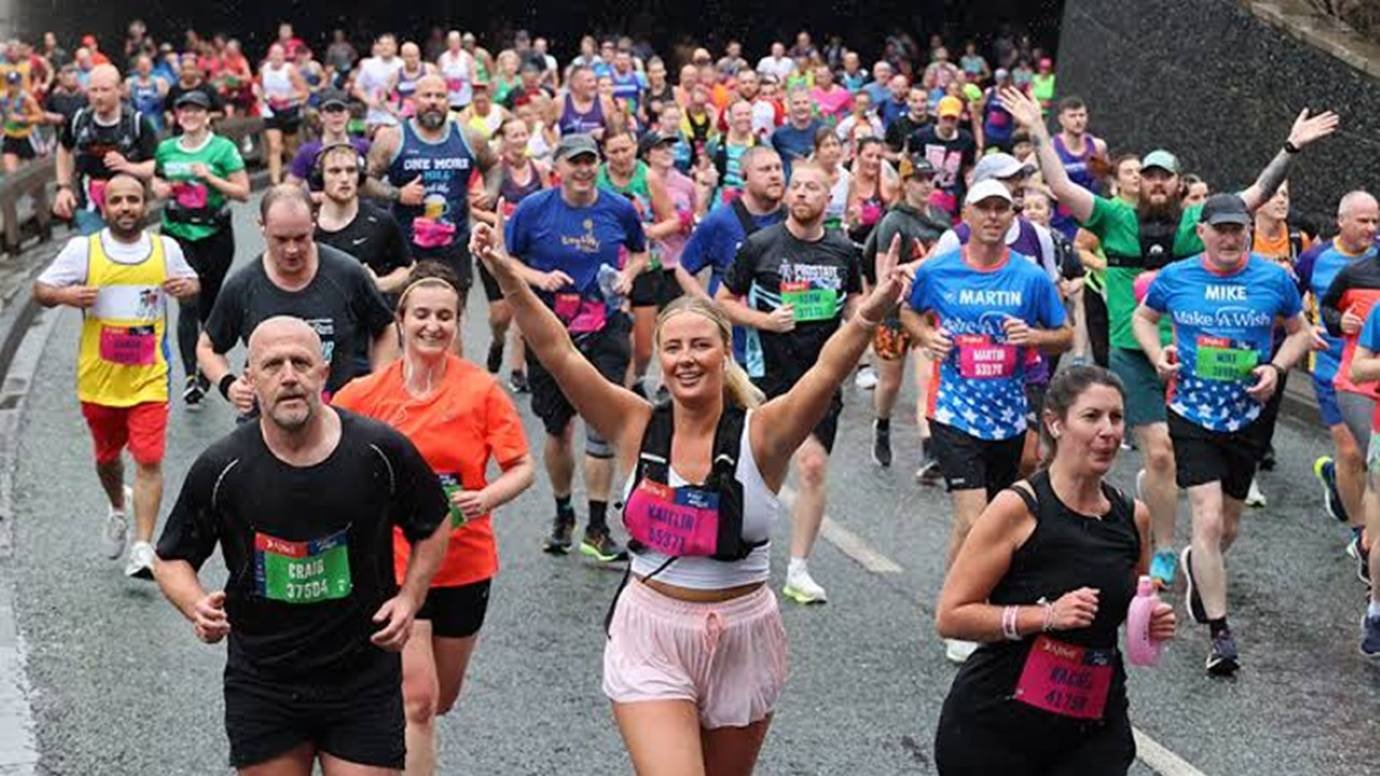
Sixty-three thousand runners on a single start line is not an abstract statistic. It means the opening mile of the Great North Run has a noise level and an energy you will not find at any other half marathon on the planet. The crowd on the Central Motorway overpasses, the runners streaming off the start in a river of colour, the helicopters overhead — it takes about two minutes to realise this race is genuinely different. More than 200,000 spectators line the route from Newcastle to South Shields. In 45 editions, the race has attracted runners from 178 different countries. The 2027 edition is projected to carry the cumulative finisher count past 1.5 million people.
The Course Tells a Real Story
Most road races loop or double back. The Great North Run goes in one direction only: city to coast. You start on a motorway above Newcastle’s rooftops, cross the Tyne Bridge, press through Gateshead and Jarrow, and finish on a seafront with the North Sea in front of you. That sense of journey — of actually travelling somewhere — makes the course feel meaningful in a way that out-and-back routes rarely do. Every landmark means something: the Tyne Bridge at mile two signals you’ve left the city, the John Reid Roundabout at mile eight signals the hard part begins and South Shields seafront at mile thirteen means you’ve made it.
Crowd Support Runs the Full 13.1 Miles
Many races have great crowd sections and dead patches. The Great North Run has almost none. Bands are stationed along the course at regular intervals, from the Brooks DJ zone just after mile two to live musicians on the Gateshead side of the Tyne Bridge to country bands at mile six. The Red Arrows fly over the start. The final mile at South Shields has a Motivation Station that puts personalised spectator messages on a big screen as you run past. The Great Run app lets supporters track runners in real time, so people are actually waiting for specific runners rather than just watching a crowd go by.
Is the Great North Run a Good Course for a Personal Best?
On paper, yes. The net downhill from Newcastle to South Shields makes this a technically fast course, and the records back that up — Mathathi’s 58:56 and Kosgei’s 1:04:28 are among the fastest half marathon times ever run in the UK. In practice, the answer depends entirely on your strategy. Runners who execute the early miles conservatively and have done specific hill work for Marsden Bank regularly run faster here than on flat courses. Runners who go out hard on the first-mile descent and have no hill training almost always die between miles eight and twelve. The course will give you a PB if you respect it. It will take two or three minutes from you if you treat it like a flat fast-finish race.
The Charity Dimension Is Embedded in the Race’s DNA
The Great North Run has raised hundreds of millions of pounds for charity since 1981. Running for a cause is not a side feature here — it is central to how the race was conceived and how most runners experience it. Charity places are widely available across hundreds of organisations, and the fundraising infrastructure around the event (charity cheering buses on the course, dedicated charity villages at the finish) is more developed than almost any other race in the world. If you are torn between waiting for the ballot and taking a charity place, the charity route guarantees your entry and gives the run an additional purpose that many runners find makes the training easier to maintain.
Who Should Run the Great North Run?
First-time half marathon runners benefit from the atmosphere and the crowd support, which carry people through the tough middle miles. Experienced runners who have not run it before will find it a legitimately interesting course challenge. International runners visiting the UK specifically for a race will find Newcastle is a compact, welcoming city with good transport links, a strong food and pub culture and a local population that genuinely gets behind the event. The one runner who should be cautious is someone targeting an aggressive PB on their first GNR — learn the course first, then chase the time on a return visit when you know exactly what miles eight to twelve feel like.
The Great North Run Course: Mile by Mile
- Distance: 13.1 miles (Half Marathon)
- Start Elevation: ~100ft (A167 Central Motorway, Newcastle)
- High Point: ~201ft (Black Bull Junction, mile 5)
- Finish Elevation: Sea level (South Shields seafront)
- Total Gain: ~430ft (~130m)
- Net: Downhill overall — city to coast
- Surface: Closed tarmac roads throughout
- Course Style: Point-to-point, no loop
- Key Landmarks: Tyne Bridge (mile 2), Black Bull Junction (mile 5), John Reid Roundabout (mile 8), Marsden Bank (miles 8-12), South Shields Seafront (finish)
Miles 1-2: The Central Motorway Start and Tyne Bridge
The race starts on the A167 above Newcastle city centre, and the first mile drops 60 feet in a single sustained descent. It is the fastest mile on the course and the most dangerous. With 63,000 runners around you and the noise from the crowd on the bridges overhead, it is almost impossible to feel like you are going too fast. You are almost certainly going too fast. At mile two you cross the Tyne Bridge — the most photographed moment in Great North Run history. The grade is gentle here, the river below you, and the crowd noise can be disorienting. Take a second to look around if this is your first time. Then get back to your watch and make sure you’ve been honest about what you’ve spent so far.
Miles 3-5: The Gateshead Climb to the Course High Point
After the bridge the road enters Gateshead and the first real climbing begins. Over miles three to five the course gains 104 feet, cresting at the Black Bull Junction around mile five at approximately 201 feet above sea level. This is the highest point on the course. The gradient is sustained rather than steep — nothing that would give an experienced runner trouble in isolation. But runners who have hammered the first-mile descent arrive at this climb with fatigued quads and eight miles still to run. The medical tent is positioned just before mile five. It is there for a reason.
Miles 5-8: Team Valley and the Deceptive Downhill
From the course high point at mile five the road drops over 40 metres down through Team Valley toward the John Reid Roundabout at mile eight. This is the most psychologically dangerous stretch on the course. The gradient is gentle and inviting, the crowds thin slightly, and the legs feel like they have found their rhythm after the Gateshead effort. Most runners relax here and let the pace drift five to ten seconds per mile faster than planned. That is a mistake. Everything borrowed on this descent is repaid with interest between miles eight and twelve. Hold your goal pace here and nothing else. When you reach the John Reid Roundabout feeling comfortable, you have paced it correctly.
Miles 8-12: Marsden Bank, Where Races Unravel
This is the race. A sustained four-mile climb through Jarrow and up Marsden Bank is where the Great North Run separates runners who prepared from runners who didn’t. The gradient is not extreme by trail running standards but it is relentless, and it arrives after seven miles of mostly downhill running that has been quietly destroying your quads. Braking on descents is harder work than most recreational runners account for. By mile eight your legs are already carrying fatigue you may not have registered, and four miles of climbing will find it. Recreational runners who paced the early miles correctly lose around 30-60 seconds to this section compared to their target. Runners who went out fast on the descent lose two to four minutes. There is no shortcut once you are in it.
Miles 12-13.1: The Coast Road to South Shields Seafront
At mile twelve, if you look ahead, the North Sea appears. The road tips sharply downhill toward the coast before levelling onto the A183 Coast Road for the final mile to the finish on South Shields seafront. The crowd builds again, the Motivation Station big screen is showing personalised messages from spectators, and the finish line is real. One thing to prepare for: the coastal exposure means wind. The final mile can be sheltered and fast if the wind is behind you or demanding if it is a headwind. You have been running in relatively sheltered streets through Newcastle and Gateshead for most of the race. The change in conditions in the last mile catches runners who haven’t experienced it before.
Great North Run Race Day Strategy
The most common GNR mistake is not going out too fast on mile one — though thousands do exactly that. It is going out at a controlled pace on miles one and two, feeling good at the Tyne Bridge, then letting the pace drift 10-15 seconds per mile faster than planned on the gentle Team Valley descent between miles five and eight. When the Marsden Bank climb begins at mile eight, that extra effort becomes a wall.
Pacing prescription: Whatever your goal pace is, run miles one and two 15-20 seconds per mile slower. Cross the Tyne Bridge in control. On the Team Valley descent between miles five and eight, hold your goal pace exactly and resist every temptation to push. If you arrive at the John Reid Roundabout at mile eight feeling comfortable, you have banked something for Marsden Bank. If you are already working hard at the roundabout, back off five seconds per mile immediately — there are four miles of climbing still ahead and no good options if your legs are already empty.
Miles 8-12 on Marsden Bank: Shift to effort rather than pace. Keep your breathing controlled, shorten your stride slightly, and keep moving. Do not look at your watch every 30 seconds. Focus on maintaining form and getting to mile twelve with something left.
The final mile: If you are running into a headwind off the coast, find a runner of similar pace and tuck in directly behind them rather than running in open air. On a calm or tailwind day, open up what is left — the course is flat and the finish is close.
Training note: The Great North Run rewards hill-specific preparation more than almost any other major half marathon. Including sustained uphill efforts in training — particularly back-to-back hill segments after seven or eight miles of running — will pay off more on Marsden Bank than interval track sessions.
Great North Run Race Weekend Schedule 2026
| Date | Event | Time (BST) | Location |
|---|---|---|---|
| Friday, September 11 | Great North 5K (elite and mass participation) | From 5:00pm | Newcastle Quayside |
| Saturday, September 12 | Junior Great North Run (ages 11-16) and Mini Great North Run (under 11s) | From 8:45am | Newcastle, Quayside |
| Sunday, September 13 | BBC live coverage begins | 10:00am | BBC One / BBC iPlayer |
| Sunday, September 13 | Elite wheelchair race | 10:20am | A167, Newcastle |
| Sunday, September 13 | Elite women’s race | 10:25am | A167, Newcastle |
| Sunday, September 13 | Red Arrows flyover | ~10:50am | Start area, Newcastle |
| Sunday, September 13 | Mass participation waves (colour-coded by wave) | After elite starts; check run number for wave time | A167, Newcastle |
| Sunday, September 13 | AJ Bell Live Stage — finish line entertainment, interviews and live podcast | From 10:00am | Event village, South Shields seafront |
Exact start times for mass participation waves are confirmed on your run number. Runners must arrive at the assembly zone at least 90 minutes before their wave start. Use the Tyne and Wear Metro rather than driving; road closures cover most of the city centre and there is no dedicated race day parking.
Great North Run Expo and Packet Pickup
The Great Run Company sends run packs (including your race number and timing chip) by post to most registered participants in the weeks before the event. Check your registration confirmation for the expected dispatch window. Most runners do not need to collect in person.
For runners who have not received a pack, or who have queries about their number, in-person collection is available from the Great Run Company at a designated venue in Newcastle city centre. Specific venue address and collection hours for 2027 are confirmed by the Great Run Company closer to race date — check greatrun.org for updated details.
What to bring if collecting in person: Your confirmation email and a photo ID.
Race expo: The Great North Run weekend includes a running expo with exhibitors, brand activations and race merchandise. Details including location and opening times for 2027 are published on the official website closer to the event.
Great North Run Weather: What to Expect in September
Newcastle in September is cooler and more variable than most runners trained in warmer climates expect. The race takes place in early to mid-September, which puts it at the tail end of British summer — conditions can range from warm Indian-summer sunshine to cool overcast days with a North Sea breeze. In most years, temperature is not a significant race-day concern. Wind at the coastal finish is the more common factor to plan around.
| Condition | Typical September Range | 2026 Race Day (Actual) |
|---|---|---|
| Morning Temperature | 12-14°C (54-57°F) | 13-14°C (55-57°F) |
| Midday Peak | 15-18°C (59-64°F) | 18°C (64°F) |
| Sky Conditions | Variable — sun, cloud, light rain all possible in one day | Mostly cloudy with sunny intervals |
| Wind | Moderate inland; stronger at South Shields coastal finish | Moderate, coastal gusts at finish |
| Humidity | 70-85% | Up to 90% |
| Rain Chance | 20-30% | 10% (11am-2pm window only) |
The most important weather variable to check in race week is coastal wind direction at South Shields. The final mile runs exposed on the A183 Coast Road and can feel significantly cooler and windier than the sheltered streets through Newcastle and Gateshead that precede it. A 15km/h headwind in that last mile is uncomfortable but manageable if you know it is coming. Dress in lightweight, windproof layers that are easy to tie at the waist once you warm up in the first few miles. Bin bags at the start are standard practice for most runners waiting in assembly zones.
Great North Run 2026 Results and Past Champions
The 2026 edition was the 45th Great North Run and the biggest ever by field size. The women’s race was defined by Brigid Kosgei’s controlled solo run after Eilish McColgan’s early withdrawal. The men’s race was tighter, with American Zouhair Talbi holding off Kenya’s Alex Mutiso by 14 seconds.
2026 Women’s Elite — Top 10
| Place | Name | Country | Time |
|---|---|---|---|
| 1 | Brigid Kosgei | Kenya | 1:06:15 |
| 2 | Sheila Chepkirui | Kenya | 1:08:19 |
| 3 | Melknat Wudu | Ethiopia | 1:09:37 |
| 4 | Honami Maeda | Japan | 1:09:43 |
| 5 | Amy-Eloise Neale | Great Britain | 1:10:27 |
| 6 | Natosha Rogers | United States | 1:11:44 |
| 7 | Annabel Gummow | Great Britain | 1:12:37 |
| 8 | Nancy Scott | Great Britain | 1:12:51 |
| 9 | Amelia Quirk | Great Britain | 1:13:09 |
| 10 | Rebecca Weston | Great Britain | 1:13:51 |
2026 Men’s Elite — Top 10
| Place | Name | Country | Time |
|---|---|---|---|
| 1 | Zouhair Talbi | United States | 59:47 |
| 2 | Alex Mutiso Alex | Kenya | 1:00:01 |
| 3 | Yohei Ikeda | Japan | 1:00:40 |
| 4 | Casey Clinger | United States | 1:01:36 |
| 5 | Kosei Matsunami | Japan | 1:01:59 |
| 6 | Shouya Yonei | Japan | 1:02:01 |
| 7 | Clayton Young | United States | 1:02:04 |
| 8 | Marc Scott | Great Britain | 1:02:10 |
| 9 | Joe Hudson | Great Britain | 1:02:22 |
| 10 | Yuki Takei | Japan | 1:02:50 |
2026 Wheelchair Results
| Category | Winner | Country | Time |
|---|---|---|---|
| Men’s Wheelchair | David Weir | Great Britain | 43:06 |
| Women’s Wheelchair | Melanie Woods | Great Britain | 50:19 |
Course Records
| Category | Record Holder | Country | Time | Year |
|---|---|---|---|---|
| Men’s | Martin Mathathi | Kenya | 58:56 | 2011 |
| Women’s | Brigid Kosgei | Kenya | 1:04:28 | 2019 |
| Men’s Wheelchair | David Weir | Great Britain | 41:34 | 2009 |
| Women’s Wheelchair | Amanda McGrory | United States | 49:47 | 2009 |
Full historical results and the complete 2026 results archive are available at the official timing page.
How to Watch and Where to Stand: Great North Run Spectator Guide
More than 200,000 spectators typically line the route from Newcastle to South Shields. The best approach is to pick one viewing location and commit to it — the road closures and sheer number of people make moving between spots mid-race genuinely difficult. Use the free Great Run app to track your runner in real time so you know exactly when to be ready.
| Viewing Spot | Course Point | How to Get There | Notes |
|---|---|---|---|
| Start Area / Town Moor | Pre-start | Metro to Haymarket; follow marshals | See runners in assembly zones; atmosphere builds before 10am |
| Brooks Hype Zone | Just after mile 2 | Metro to Monument, short walk into Gateshead | DJ, loud music; one of the best atmosphere spots on the course |
| Bands on the Run Stage | Gateshead side, mile 2-3 | Metro to Gateshead | Live musicians; note Tyne Bridge itself was restricted to spectators in 2026 due to road works — verify for 2027 |
| A Country Mile Zone | Just after mile 6 | Car or bus; check road closure map | Country music entertainment; less crowded than mile 2 zones |
| John Reid Roundabout | Mile 8 | Car (park before road closures); bus | Start of Marsden Bank; good spot to give your runner a real boost before the hard section begins |
| South Shields Finish / Event Village | Mile 13.1 | Metro direct to South Shields station; shuttle buses from Newcastle | AJ Bell Live Stage from 10am; Motivation Station big screen; food village; meet your runner in designated family reunion areas |
| Screen on the Green | N/A (city centre) | Old Eldon Square, Newcastle City Centre | BBC coverage on big screen from 10am-2pm; deckchairs and city buzz; good option if you want to watch the elite race before heading to a course spot |
Where to Stay for the Great North Run
Most runners base themselves in Newcastle or Gateshead, where the Metro connects both ends of the course. South Shields is quieter and closer to the finish but has fewer hotel options. Book as soon as you secure your place — the race weekend sells out accommodation across the city, and race-adjacent hotels typically fill months in advance.
| Area | Hotels / Options | Price Range (Race Weekend) | Best For |
|---|---|---|---|
| Newcastle City Centre | Malmaison Newcastle, Hotel Indigo Newcastle, Premier Inn (multiple sites), Travelodge Newcastle Central | £80-£200/night | Start line access; widest range of restaurants and pubs for pre-race carb loading and post-race celebration |
| Gateshead Quayside | Hilton Newcastle Gateshead | £120-£250/night | River views; overlooks the Tyne Bridge crossing area; excellent Metro links to both ends of course |
| Newcastle Quayside | Copthorne Hotel Newcastle, Roomzzz Newcastle (serviced apartments) | £100-£200/night | Walking distance to start; good for larger groups or those who want apartment-style space |
| South Shields | Travelodge South Shields, local B&Bs | £60-£120/night | Finish line proximity; quieter than city centre; good if you plan to stay for the post-race event village |
Getting to Newcastle for the Great North Run: International Runners
| Nationality | Entry Requirement | Where to Apply |
|---|---|---|
| EU and EEA citizens | UK Electronic Travel Authorisation (eTA) required since January 2024 | gov.uk/apply-for-an-eta |
| USA, Canada, Australia, New Zealand | UK eTA required | gov.uk/apply-for-an-eta |
| India | UK Standard Visitor Visa required | gov.uk/standard-visitor-visa |
| All other nationalities | Check individually via official UK government visa checker | gov.uk/check-uk-visa |
By air: Newcastle International Airport (NCL) has direct connections from London Heathrow (British Airways), Amsterdam Schiphol (KLM), Dublin (Ryanair and Aer Lingus), Paris Charles de Gaulle (Air France) and multiple other European hubs. For runners travelling from India, the most convenient routing is Delhi (DEL) or Mumbai (BOM) to London Heathrow, then either a connecting domestic flight to Newcastle (approx. 1 hour) or the LNER train from London King’s Cross (see below).
By train from London: The LNER East Coast Mainline runs from London King’s Cross to Newcastle in approximately 3 hours, with trains every 30 minutes at peak times. This is often more convenient than flying from London, as King’s Cross is central and Newcastle station puts you five minutes’ walk from the city centre. Advance tickets booked months ahead are significantly cheaper than walk-up fares. Book at lner.co.uk. Race weekend trains fill up — book on the same day you secure your ballot place.
Race day transport: The Tyne and Wear Metro is the only practical option on race morning. Extensive road closures cover the entire route from Newcastle to South Shields. Driving into the city is not recommended. Metro services run enhanced timetables on race day. No pre-booking required — pay on arrival using contactless.
The History of the Great North Run
The Great North Run was created by Brendan Foster — Olympic 10,000m bronze medallist at the 1976 Montreal Games and later a BBC Sport commentator. Foster’s idea was simple: a half marathon through the streets of his home region that anyone could enter. On June 28, 1981, 12,264 people lined up on the Central Motorway in Newcastle. Mike McLeod, a local Olympian from Northumberland, won in 1:03. Karen Goldhawk was the first women’s winner in 1:17. Fourteen hundred volunteers organised it. Almost nobody expected what would follow.
Within a decade the race had outgrown its founding vision. In 1992 it hosted the inaugural IAAF World Half Marathon Championships. By 2011 the field had reached 54,000, with Martin Mathathi of Kenya setting the men’s course record of 58:56 that still stands. In 2014 Tracey Crammond became the millionth person to finish the Great North Run — the same year the event broke the Guinness World Record for the largest half marathon. By 2016, runners from 178 different countries had crossed the start line, more nationalities than any other single running event in history. The total finisher count passed 1.4 million before the 2027 race, with the 2027 edition projected to push it past 1.5 million.
The race has been shaped by a handful of extraordinary athletes. Mo Farah won six consecutive Great North Runs from 2014 to 2020 — more wins than any other man. Paula Radcliffe won six times on the women’s side (2000, 2001, 2003, 2004, 2006 and 2007). Brigid Kosgei set the women’s course record of 1:04:28 in 2019 and returned in 2026 to win the 45th edition, running most of it alone after Eilish McColgan’s withdrawal. The race has a World Athletics Heritage Plaque. And it has raised hundreds of millions of pounds for charity since that first June morning in 1981 when Brendan Foster’s local fun run turned out to be something considerably larger.
FatMarathoner Verdict: Is the Great North Run Worth Entering?
The Great North Run is one of those races where the whole is genuinely bigger than the sum of its parts. The course is not easy — miles 8-12 on Marsden Bank will test you, and if you go out too hard on that first-mile descent, the bill comes due on the climb. The coastal wind at South Shields in the final mile is real. The ballot means you might not get in. None of that is a reason to skip it.
The atmosphere on race day is unlike anything else in half marathon running. City to coast, 63,000 people, Red Arrows overhead, a crowd that is actually invested in the event rather than just standing on the pavement. The Tyne Bridge crossing at mile two is one of the great moments in global road racing. And Newcastle is a genuinely excellent city to spend a race weekend in — compact, welcoming and easy to navigate.
For international runners making a trip specifically for a race: yes, this one is worth the journey. For Indian runners: the logistics from Delhi or Mumbai are not trivial, but runners who have done the GNR consistently rate it among the best race experiences they have had anywhere. Enter the ballot now. If you miss September, the January ballot gives you a second chance. If the ballot fails twice, charity places are available across hundreds of organisations.
The 2027 ballot closes at midnight on September 20, 2026. You have a week. Enter it.