Last updated: August 2026
📅 Race date: Sunday, December 6, 2026 | Edition: 44th California International Marathon
🤝 Presenting sponsor: Sutter Health (7-Year Partnership)
⏰ Start time: 7:00 AM mass start (wheeled/adaptive athletes: 6:53 AM)
📍 Start: Near Folsom Dam, Folsom, CA (elevation 366 ft / 112m)
🏁 Finish: California State Capitol, Sacramento, CA (elevation 26 ft / 8m)
📏 Distance: 42.195K Marathon
⛰️ Elevation: Net drop 366 ft (111.5m) — rolling hills first 21 miles, flat and fast final 5
👟 Field size: ~8,000–9,000 finishers
⏱️ Time limit: 6 hours — finish line closes 1:30 PM sharp (enforced by CHP sweep car at 13:44/mi pace)
⭐ Special status: 2026 USATF Men’s and Women’s National Marathon Championships
🎟️ Entry: Tiered registration — standard tiers sold out; transfer portal opens Oct 1 via Race Roster
💰 Prize money: $116,500 total purse ($20,000 to 1st place USATF field) + 2028 OTQ bonus of $500 + Bib Displacement Bonuses
🥤 On-course fuel: Precision Fuel & Hydration (Drink mix at all 17 stations; Gels at miles 6.4, 13.6, 21.4)
🧦 Finisher swag: Custom CIM-branded OS1st Compression Recovery Socks
🍂 Race weather: Mid-40s to low 50s°F (7–12°C) at gun — cool, crisp, often misty — ideal marathon conditions
✈️ Nearest airport: Sacramento International Airport (SMF) — 20 min from downtown
🌐 Race website: runsra.org/california-international-marathon · @runcim262 · @runsra_cim
Most marathons either test your patience with a lottery or test your ego with a qualifying time. The California International Marathon (CIM) does neither. Since 1983, managed by the non-profit Sacramento Running Association (SRA), it has simply set up shop on the first Sunday of December, pointed runners from Folsom Dam toward the California State Capitol and said: go as fast as you possibly can.
That simplicity is the point. The CIM course has not changed in over four decades. It starts near Folsom Dam in the foothills east of Sacramento, drops 366 feet over 26.2 miles through fall-coloured suburbs and tree-lined boulevards, and finishes on Capitol Mall in front of one of the most recognisable buildings in the American West. Following SRA’s landmark acquisition of Capital Road Race Management (CRRM), the regional race operations and timing infrastructure are more unified than ever. Combined with a 7-year presenting partnership with Sutter Health and expanded hydration architecture from Precision Fuel & Hydration, CIM sets the gold standard for high-performance marathons.
The 44th edition of the CIM runs on Sunday, December 6, 2026, and it carries extra weight. The Sacramento Running Association has been selected to host the 2026 USATF Men’s and Women’s Marathon Championships — the second consecutive year CIM has held that title. Following a historic cycle that saw men’s and women’s course records broken and over 100 runners hitting 2028 Olympic Trials qualifying standards in a single morning, CIM is not just fast. It is proven.
If you have a PR to chase, a BQ to lock in or you simply want to run a race where the best American distance runners in the country are on the same start line as you, this is the one.
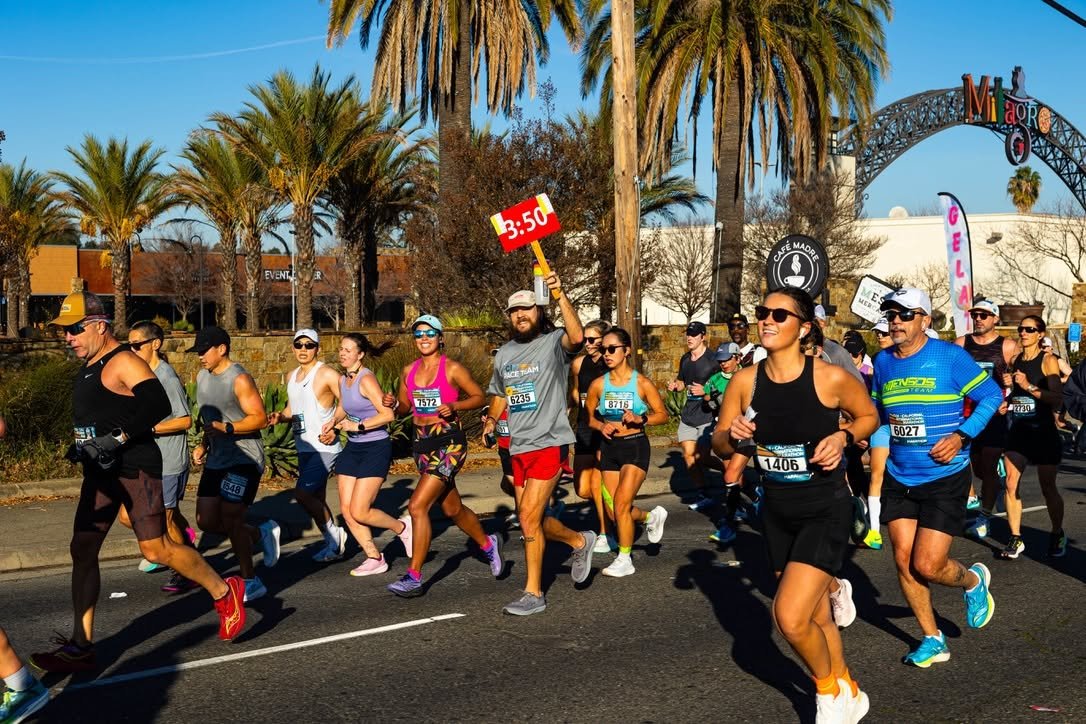
California International Marathon 2026 — Race at a Glance
| Detail | Information |
|---|---|
| Full name | California International Marathon (CIM) |
| Presenting Sponsor | Sutter Health |
| Edition | 44th CIM |
| 2026 race date | Sunday, December 6, 2026 |
| Start time | 7:00 AM mass start (adaptive athletes 6:53 AM) |
| Start location | Near Folsom Dam, Folsom, CA |
| Finish location | California State Capitol, Sacramento, CA |
| Distance | 42.195K Marathon |
| Time limit | 6 hours — finish line closes 1:30 PM sharp (CHP sweep car enforces 13:44/mi pace) |
| Special status | 2026 USATF National Marathon Championships (men’s and women’s) |
| Entry | Tiered registration — all standard 2026 tiers sold out; official transfers open Oct 1 |
| Elevation | Net drop 366 ft (111.5m) — rolling hills to flat 5-mile finish |
| Field size | ~8,000–9,000 finishers |
| On-Course Nutrition | 17 stations — Precision Fuel Carb & Electrolyte Drink Mix throughout; PF 30 Gels at miles 6.4, 13.6, and 21.4 |
| Finisher Swag | Custom CIM-branded OS1st Compression Recovery Socks + Medal |
| Course type | Point-to-point, net downhill, USATF certified (Boston & OTQ compliant) |
| Organiser | Sacramento Running Association (501(c)(3) nonprofit) |
| Race website | runsra.org |
What Makes the California International Marathon Worth Running?
It Is the Fastest Course in the West — and the Numbers Back That Up
The CIM boasts an extraordinary 30.2% Boston qualifying rate. Nearly one in three runners who finish this race goes home with a BQ. No other marathon in the country comes close to that consistency, leading Runner’s World, RaceRaves, and Outside to repeatedly rank CIM as the premier Boston qualifier in North America. The combination of a net-downhill course, cool December temperatures, and a flat final 5 miles creates conditions where the clock genuinely cooperates. If you have a time goal, this is the course that gives you the best chance to hit it.
The Course Has Not Changed in Over 40 Years
The route SRA created for the 1983 inaugural CIM is the exact same route you will run in December 2026. Same start near Folsom Dam. Same finish on Capitol Mall. Same fall-coloured tree canopy through Orangevale, Citrus Heights, Fair Oaks, and Carmichael. Every course record and personal best in CIM history happened on the identical course you will run, allowing you to race directly against four decades of American distance running history.
December in Sacramento Is Ideal Marathon Weather
Early December in Sacramento sits in a narrow climatic window between warm autumn and wet winter. Average temperatures at race time are in the mid-40s to low 50s Fahrenheit (7–12°C). Overcast skies and valley mist are common in the early miles, keeping heat stress near zero. Rain is possible but rare. It is an environment built for peak physical output.
2026 Is a USATF National Championship Year
The Sacramento Running Association is hosting the USATF National Marathon Championships again in 2026. This elevates the field depth dramatically, featuring a $116,500 prize purse, Olympic Trials bonuses, and national broadcast coverage. You will be running the same roads as the top American distance runners competing on their primary domestic stage.
It Produces More Olympic Trials Qualifiers Than Any Other US Marathon
CIM holds the world record for performance depth. Over 100 runners regularly hit Olympic Trials qualifying standards in a single morning here (sub-2:16:00 for men, sub-2:37:00 for women). That depth creates powerful packs on the road — serious runners pushing serious tempos, pulling everyone around them toward breakthroughs.
The Finish at the California State Capitol Is Unmatched
CIM finishes on Capitol Mall, with the historic 1874 California State Capitol building dominating the view ahead as you turn from L Street onto 8th Street and make your final sprint. Framed by crowds and downtown architecture, it remains one of the most memorable finish stretches in North American road racing.
The CIM Course — What to Expect Mile by Mile
A 26.2-mile point-to-point course from Folsom Dam through Orangevale, Citrus Heights, Fair Oaks, and Carmichael, terminating at the California State Capitol. Net elevation drop of 366 feet (111.5 meters). Rolling hills dominate the first 21 miles before transitioning to a flat, fast final 5 miles. Features 17 aid stations powered by Precision Fuel & Hydration. Fully USATF certified.
🏁 The Start — Folsom Dam, Elevation 366 Feet (Miles 0 to 3)
The start area sits near Folsom Dam in the foothills east of Sacramento. At 7:00 AM in early December, it is crisp and dark. The opening miles descend through the American River Canyon area, with the first aid station appearing at mile 2.2. The early gravity gradient tempts runners to surge. Resist this urge: the opening downhill feels effortless, but pushing here burns quads that you will desperately need in the final 10K.
- ZERO Gear Check at Folsom Start: SRA does NOT offer gear check at the Folsom start line. Discarded clothing at the start corrals is collected by volunteers and donated to local charities. All checked gear bags MUST be dropped off during Expo hours or at downtown bus loading on race morning.
- Mandatory Shuttle Transportation: Driving, personal drop-offs, or rideshares to the Folsom start are strictly prohibited by local law enforcement. All participants must ride the free SRA shuttle buses departing from Designated Locations A through E.
- Start-Line Lactation Infrastructure: SRA provides a dedicated, semi-private pumping facility inside Baja Fresh at the Folsom start line. Checked pump bags are transported by staff to the finish line retrieval area (expressed milk cannot be stored/transported due to health regulations; disposal bins provided).
🌲 Orangevale and the Canyon Descent — Miles 3 to 8
Passing Casa Roble High School at mile 3.1 — the race’s first major spectator cheer zone — the course enters residential Orangevale. Fall foliage lines the canyon roads with copper and gold canopy. Focus on establishing a smooth rhythm and staying relaxed as the cold morning air warms up.
🏘️ Citrus Heights and Fair Oaks — Miles 8 to 14
The route moves onto Fair Oaks Boulevard, the operational spine for the middle miles. Here, the terrain becomes continuously rolling. Managing effort on these small climbs and descents is vital: let your pace drop 5–10 seconds on the uphills and regain momentum on the downhills. Pushing up hills between miles 8 and 14 is the quickest way to destroy your finish.
The official Halfway Cheer Zone and In-Shape Relay Exchange sits at Fair Oaks Blvd and Manzanita Ave (Mile 13.1/13.4), serving as a huge emotional boost at the race’s midpoint.
🌳 Carmichael and the Flat Transition — Miles 14 to 20
Passing Carmichael Park (Mile 14.1), the rolling profile gradually flattens. As you pass the Precision Fuel Cheer Zone at Watt Ave (Mile 19.4), the course reaches the famous CIM Breakthrough Zone at Mile 20.5 (The Pavilions). SRA intentionally clusters cheer squads, DJ booths, and spectator stands here to carry runners through the psychological wall.
🏛️ Sacramento City and the Capitol Finish — Miles 20 to 26.2
Crossing the Guy West Bridge, the course enters Sacramento proper, taking J Street into Midtown and picking up L Street. At Mile 24.4, runners pass through the massive Sutter Health “Never Stop Zone”, followed immediately by the Fleet Feet Cheer Zone at 23rd & L Street (Mile 25.0). Turning right onto 8th Street and left onto Capitol Mall, the State Capitol comes into full view for the final dash across the finish line.
The biggest mistake at CIM is treating the first 10 miles as “free miles” due to the net drop. Eccentric muscular loading on downhills severely fatigues the quadriceps if unmanaged.
- Start 10–15 seconds slow: Treat the opening 5 miles as a warmup, regardless of how effortless the downhill feels.
- Shorten your stride on descents: Avoid overstriding on early downhill drops to protect your quads for the final 5 flat miles.
- Run by effort, not watch pace: Allow pace to fluctuate naturally on the rolling hills between Miles 8 and 18.
- Fuel early and often: Take Precision Fuel drink mix at aid stations and utilize the gel stations at Miles 6.4, 13.6, and 21.4.
- Wear throwaway clothes: Pre-race wait times in Folsom can be chilly (40°F/4°C). Wear extra layers that you can drop in the corral for charity collection.
How to Register & Entry Rules for CIM 2026
CIM uses a demand-driven tiered registration structure. High demand causes general entries to sell out months in advance.
Registration Tiers & Policies Explained
| Tier | Price | Peer Transfer | Relay Transfer | Deferral Option | Refund Policy |
|---|---|---|---|---|---|
| Blue — Unprotected | $180 | No | No | No | Non-refundable |
| Orange — Standard | $200 | Yes (via portal) | Yes | No | Non-refundable |
| Gold — Worry-Free | $230 | Yes (via portal) | Yes | Yes (to 2027) | Non-refundable |
If you miss standard registration, SRA operates an official transfer portal via Race Roster open between October 1 and November 16. Buyers pay a $180 Blue Tier fee plus a $50 administrative processing fee, allowing original registrants (Orange/Gold) to receive a refund for their entry fee. Unauthorized bib reselling is strictly prohibited to ensure accurate emergency medical tracking.
Inclusion & Accessibility Policies: SRA offers comprehensive deferral and refund protections for pregnant and postpartum participants without requiring formal medical notes. Additionally, SRA runs the Mile 1 Program (providing fully funded entries for first-time marathoners from underrepresented backgrounds) and the RunSac Program (reserving guaranteed spots for local series runners).
Race Weekend Schedule — December 4 to 6, 2026
| Date | Event | Time and Details |
|---|---|---|
| Fri, Dec 4 | CIM Expo and Packet Pickup | 12:00 PM – 7:00 PM · SAFE Credit Union Convention Center |
| Sat, Dec 5 | CIM Expo and Packet Pickup | 9:00 AM – 5:00 PM · SAFE Credit Union Convention Center |
| Sat, Dec 5 | Official CIM Shake Out Run | 8:30 AM · Convention Center Area (OS1st Compression activations) |
| Sun, Dec 6 | Downtown Bus Pickups (Loc A) | 4:00 AM – 4:30 AM SHARP · 13th & K Street |
| Sun, Dec 6 | Suburban Bus Pickups (Loc B–E) | 4:30 AM – 5:30 AM SHARP · Arden / Folsom / Granite Bay |
| Sun, Dec 6 | Adaptive Athletes Start | 6:53 AM · Folsom Dam start area |
| Sun, Dec 6 | California International Marathon | 7:00 AM mass start · Folsom Dam to State Capitol |
| Sun, Dec 6 | Start line closes | 7:30 AM sharp — no late starters allowed |
| Sun, Dec 6 | Course & Finish Area Close | 1:30 PM sharp (CHP sweep enforcing 13:44/mi cutoff) |
Expo and Packet Pickup — What You Need to Know
📅 Friday Dec 4: 12:00 PM – 7:00 PM
📅 Saturday Dec 5: 9:00 AM – 5:00 PM — no race-day packet pickup
🎟️ Bring: Photo ID + Registration Confirmation QR Code
👥 Proxy pickup: Allowed — representatives must bring your QR code and a copy of your photo ID
The Expo features gear exhibits, Precision Fuel strategy booths, official merchandise, and sock sizing stations hosted by OS1st. Relay teams pick up together (one member can collect both bibs using both QR codes).
CIM Race Weather — Early December in Sacramento
| Condition | Typical for December, Sacramento |
|---|---|
| Start temperature (7 AM) | Mid-40s to low 50s°F / 7–12°C — cold at the gun |
| Temperature by 10 AM | Mid-50s to low 60s°F / 12–16°C — optimal running range |
| Humidity & Fog | Moderate — morning valley mist common, clearing by Mile 10 |
| PR suitability | Exceptional — among the top racing climates in North America |
Prize Money & Elite Structure — 2026 USATF Championships
With host status for the USATF National Marathon Championships, SRA operates a $116,500 dedicated national prize purse alongside performance incentives.
Championship Prize Purse Breakdown
| Finish Position | Men’s Division | Women’s Division | Eligibility Criteria |
|---|---|---|---|
| 🥇 1st Place | $20,000 | $20,000 | Gun Time; USATF / US Citizen eligible |
| 🥈 2nd Place | $12,500 | $12,500 | Gun Time |
| 🥉 3rd Place | $9,000 | $9,000 | Gun Time |
| 4th Place | $6,500 | $6,500 | Gun Time |
| 5th Place | $5,000 | $5,000 | Gun Time |
| 6th–10th Place | $4,000 down to $500 | $4,000 down to $500 | Gun Time |
Additional Elite Bonuses:
- 2028 OTQ Performance Bonus: $500 bonus for breaking 2:16:00 (men) or 2:37:00 (women), capped at a $30,000 total pool (pro-rated if over 60 athletes achieve standard).
- Bib Guarantee & Displacement Bonuses: Top 10 seeded runners receive bib appearance guarantees ($100–$1,000). Unseeded or lower-seeded runners who beat top-10 bib holders earn a $100 bonus for every higher-numbered bib displaced, provided they finish in the top 10 overall.
- Course / American Records: $5,000 course record bonus; $10,000 American record bonus.
CIM Race Results & Defending Champions
Recent editions produced historically fast depth. Course records currently stand at 2:07:35 for men (Tsegay Weldlibanos, 2024) and 2:24:09 for women (Molly Born, 2025 debut).
| Place | Men’s Champion | Time | Women’s Champion | Time |
|---|---|---|---|---|
| 🥇 1st | Futsum Zienasellassie (USA) | 2:09:29 | Molly Born (USA) | 2:24:09 ★ |
| 🥈 2nd | Joseph Whelan (USA) | 2:09:41 | Sara Hall (USA) | 2:24:36 † |
| 🥉 3rd | Cristian Allen (USA) | 2:09:57 | Megan Sailor (USA) | 2:25:16 |
★ Women’s overall course record · † Masters course record · All podium men ran under previous American course record
Spectator Guide — Best Places to Watch CIM
Due to safety mandates, spectators are strictly barred from the Folsom start line. Crowd density focuses heavily along key sponsor cheer corridors.
| Location | Mile | Spectator Focus & Vibe |
|---|---|---|
| Casa Roble High School | 3.1 | First public access point; high youth athletic cheer support. |
| Old Town Fair Oaks | 10.1 | Fair Oaks Blvd & California Ave; historic town square atmosphere. |
| In-Shape Relay Exchange | 13.1 / 13.4 | Fair Oaks Blvd & Manzanita Ave; halfway mark, high energy relay handoffs. |
| Carmichael Park | 14.1 | South side of park; hosted by Canine Companions. |
| Precision Fuel Zone | 19.4 | Watt Ave & Fair Oaks Blvd; crucial transition zone entering final 10K. |
| CIM Breakthrough Zone | 20.5 | Fair Oaks Blvd at The Pavilions; organized crowd sound walls. |
| Sutter Health “Never Stop Zone” | 24.4 | 28th & L Street in Midtown; massive corporate cheer structures. |
| Fleet Feet Cheer Zone | 25.0 | 23rd & L Street; heavy crowd density 1 mile from glory. |
| Capitol Mall Finish Area | 26.2 | Grand grandstands facing California State Capitol. |
- Gate 1: 9th Street & N Street
- Gate 2: 10th Street & N Street
Lodging & Official Bus Shuttle Locations
Because CIM is a point-to-point race, choosing your hotel determines your morning shuttle location.
| Zone / Hub | Shuttle Location | Departure Time | Strategic Advantage |
|---|---|---|---|
| Location A: Downtown Sacramento | SAFE Credit Union Convention Center (13th & K St) | 4:00 AM – 4:30 AM | Best for most runners. Steps from Expo and Capitol finish line. Return shuttles not needed post-race. |
| Location B: Point West / Arden | DoubleTree / Hilton Arden West Lots | 4:30 AM – 5:00 AM | Mid-zone hotel hub. Return shuttles operate back to Point West hotels from N Street (11:00 AM–1:45 PM). |
| Location C: Folsom South | Century Theater 14 Lot (261 Iron Point Rd) | 5:00 AM – 5:30 AM | Allows maximum sleep in Folsom. Shortest transit time to start line. |
| Location D: Folsom North | Sam’s Club Lot (2475 Iron Point Rd) | 5:00 AM – 5:30 AM | Convenient Highway 50 local drop-off corridor. |
| Location E: Granite Bay / Roseville | Raley’s Shopping Center (6845 Douglas Blvd) | 5:00 AM – 5:30 AM | Ideal for Placer County locals and Highway 80 travelers. |
International Runners Guide
CIM draws fast international runners seeking Boston qualifiers or Olympic performance marks. Navigating US travel requires standard advance planning.
US Entry Requirements
| Origin / Passport | Requirement | Processing Guidance |
|---|---|---|
| Visa Waiver Countries (UK, Europe, Japan, Australia, etc.) | ESTA Approval | Apply online at esta.cbp.dhs.gov at least 2 weeks prior. Valid for 2 years. |
| Non-VWP Nations (India, China, South America, etc.) | B-1/B-2 Tourist Visa | Requires US consulate interview. Apply 3–4 months in advance due to appointment wait times. |
History of the California International Marathon
Founded in 1983 by the Sacramento Running Association, CIM was established to create the ultimate performance venue for marathoners. The course layout has remained unaltered for over 40 years, retaining its exact 366-foot net drop from Folsom to the State Capitol. In February 2026, SRA expanded its institutional reach by acquiring Capital Road Race Management (CRRM), unifying Northern California’s timing, equipment, and event coordination under one umbrella.
With past championship hosts in 2017, 2018, 2022, 2025, and 2026, CIM has solidified its status as an iconic American race, generating an estimated $15 million in annual regional economic impact while establishing course records that rank among the fastest ever run on American soil.
The California International Marathon does not rely on massive lotteries, extreme elevation changes, or commercial gimmicks. It has built a reputation on pure performance: a course engineered for speed, managed with precision, and timed during Northern California’s crisp December window.
The rolling hills through Fair Oaks will test your quad durability, and the zero-gear-check start requires smart race-morning planning. But as you pass through the Sutter Health “Never Stop Zone” and turn onto Capitol Mall with the California State Capitol directly ahead, you will realize why one in three runners leaves Sacramento with a Boston Qualifier.
Race day: December 6, 2026. Board your shuttle early. Respect the Folsom downhill. Protect your legs through Carmichael. Sprint Capitol Mall for everything you have left.
How CIM Compares to Other Major Marathons
| Race | Entry Type | Cutoff | Key Defining Trait |
|---|---|---|---|
| California International Marathon | Tiered (Sells Out) | 6 Hours | #1 BQ % in US · USATF Championship · Net Downhill · Deepest OTQ Field |
| Boston Marathon | Time Qualification | 6 Hours | World’s most historic marathon · Strict qualifying thresholds |
| New York City Marathon | Lottery / Charity | 8.5 Hours | Massive spectator energy across 5 boroughs · Bridges & rolling hills |
| Chicago Marathon | Lottery / Time | 6.5 Hours | World record course · Ultra-flat loop through downtown neighborhoods |
| Honolulu Marathon | Open (No Limit) | None | No time limit · Festive tropical environment · Large international walk field |
California International Marathon 2026 — FAQ
When is the California International Marathon 2026?
CIM 2026 takes place on Sunday, December 6, 2026. The mass start begins in Folsom at 7:00 AM (adaptive athletes at 6:53 AM). The start line closes sharp at 7:30 AM.
Is CIM a Boston Marathon Qualifier?
Yes. CIM is fully USATF certified and yields a 30.2% BQ rate. Its net drop of 366 feet fully complies with Boston Athletic Association rules without incurring index timing adjustments.
What is the official gear check policy at the start?
There is NO gear check at the Folsom start line. Discarded clothing left in corrals is collected for local charity. Checked finish bags must be submitted during Expo hours or at downtown bus pickup points on race morning.
How do shuttle buses work on race morning?
Private vehicle drop-offs at Folsom Dam are strictly prohibited. All runners must take official SRA buses departing from Shuttle Locations A through E between 4:00 AM and 5:30 AM depending on your hotel hub.
What happens if I need to transfer my bib?
SRA operates an official peer-to-peer transfer portal via Race Roster between October 1 and November 16. Transferred bibs incur a $180 fee + $50 admin fee, and the original seller receives a refund.
Does CIM offer lactation support for nursing mothers?
Yes. SRA provides a dedicated pumping area inside Baja Fresh at the Folsom start line, with labeled pump bag transport to the finish line retrieval zone.
What is the on-course fueling brand for CIM?
Precision Fuel & Hydration is the official partner, offering drink mix across all 17 aid stations and PF 30 energy gels at Miles 6.4, 13.6, and 21.4.
What is the strict course cutoff rule?
The time limit is 6 hours (1:30 PM finish line close). A CHP sweep car travels at a strict 13:44 per mile pace. Runners falling behind must board sweep buses or transition to sidewalks, forfeiting timing and official finish status.
Can someone else pick up my race packet at the Expo?
Yes. Proxy pickup is allowed if your representative presents your confirmation QR code and a copy of your government-issued photo ID.
Is CIM a good course for a first-time marathoner?
Yes, provided you train for downhill quad durability. The net downhill gradient and manageable field size make it ideal, but early overstriding can cause late-race muscle fatigue if unmanaged.
Related Race Guides
- Boston Marathon — CIM exists to get runners to Boston. Here’s the full guide to the race you’re training toward.
- San Francisco Marathon — California’s other iconic race. Challenging, hilly and a completely different experience to CIM’s point-to-point speed course.
- Los Angeles Marathon — Southern California’s flagship race. Worth knowing about if you’re building a West Coast marathon calendar around your CIM December slot.
- World Marathon Calendar — Planning your next race? Browse every major international race on one page.