Last updated: September 2026
📅 Race day: Sunday, 6 December 2026 — the landmark 30th edition of the race
🏆 Status: World Athletics Platinum Label Road Race · final-stage Abbott World Marathon Majors candidate — a pass at the 2026 race makes Shanghai the 9th World Marathon Major in 2027
📍 Course: Flat, fast point-to-point route from Bund Bull Plaza through Nanjing Road, Jing’an, Xintiandi and Longteng Avenue, finishing at Xujiahui Sports Park — ~25–30m of total elevation gain
🎟️ Entry: 2026 general ballot is closed · 2025 acceptance rate was just 7.2% · Guaranteed bibs still available through licensed international tour operators · Registration fee: RMB 200 (domestic) / RMB 1,150 or ~$160 USD (foreign nationals)
📆 2026 Entry Status: Ballot closed May 29 · Lottery results announced June 30 · Payment deadline passed July 20 · Tour operator packages remain the only guaranteed entry route at this stage
✂️ Cut-off: 6 hours 30 minutes from the 7:00 AM start (1:30 PM course closure), with strict 5km checkpoint cut-offs
🌍 The hook: Cape Town is confirmed as the 8th World Marathon Major — Shanghai is now the sole remaining candidate, and a pass on December 6 unlocks the Nine Star medal program for the global running community
🛂 Visa: Indian passport holders need a Chinese L-visa arranged in person via CVASC — no visa-on-arrival, no e-visa
🌡️ Weather: Shanghai in early December is cool and crisp — roughly 8.5°C average morning temperature, ~78% humidity
China’s biggest running market has been waiting a long time for a seat at marathon running’s top table — and the Shanghai Marathon is about to get there. First run in 1996 as the “Shanghai International Citizen Marathon,” the race has evolved into one of Asia’s premier distance running events, accommodating 30,000 full-marathon runners. To meet Abbott World Marathon Majors structural standards, organizers officially uncoupled the 15,000-runner 5 km Mini Marathon, converting it into a standalone event held on Saturday, December 5, 2026. This logistical shift expands the weekend capacity to 45,000 participants while streamlining start-corral staging and course flow for Sunday’s full marathon.
The Shanghai Marathon was the first race in China to earn World Athletics Platinum Label status, and it now sits one successful evaluation away from joining the Abbott World Marathon Majors — the elite circuit that currently includes Tokyo, Boston, London, Berlin, Chicago, New York, and Sydney, soon to be joined by Cape Town as the 8th Major in 2027.
The 2026 race, on Sunday, 6 December, serves as the final Stage 2 evaluation period. Shanghai successfully passed its Stage 1 candidacy audit in November 2025; a second successful evaluation at the 2026 edition would make it the 9th Abbott World Marathon Major, debuting officially on the calendar in 2027 — the same year the brand-new Nine Star medal is introduced for runners completing all nine Majors. If confirmed, Shanghai becomes mainland China’s first World Marathon Major and only the second Asian race in the series alongside Tokyo.
For runners chasing personal bests on a flat course, or looking to secure entry before Major status drives lottery odds to extreme levels, this is the pivotal moment to target Shanghai.
Race at a Glance
| Detail | Info |
|---|---|
| Full name | Shanghai Marathon (上海国际马拉松, Shanghai International Marathon) |
| Organiser | Shanghai Donghao Lansheng Sports Co., Ltd. (Donghao Lansheng Group), Shanghai Administration of Sports, in partnership with Infront and Abbott World Marathon Majors |
| Race date (2026) | Sunday, 6 December 2026 — 30th anniversary milestone edition (Standalone Mini Marathon on Dec 5) |
| First held | 1996, as the Shanghai International Citizen Marathon |
| Start / Finish | Start: Bund Bull Plaza, Huangpu River waterfront · Finish: Xujiahui Sports Park |
| Distances offered | Full Marathon (42.195km) · Wheelchair Division · Standalone 5km Mini Marathon (Dec 5) |
| Elevation gain | ~25–30 metres total — one of the flattest, fastest Majors-calibre courses in Asia |
| Cut-off time | 6 hours 30 minutes (7:00 AM start, course closes 1:30 PM), with intermediate 5km cutoff gates |
| World Athletics / AbbottWMM status | World Athletics Platinum Label Road Race · Sole remaining AbbottWMM candidate (Stage 2 final evaluation at December 6, 2026 race) · A pass makes Shanghai the 9th World Marathon Major in 2027 and activates the Nine Star medal program |
| Field capacity | 30,000 full marathon runners (expanded from 23,000) · 15,000 standalone mini marathoners |
| 2025 acceptance rate | Just 7.2% — among the most selective open marathon lotteries worldwide |
| Course records | Men: Philimon Kiptoo Kipchumba (KEN), 2:05:35 (2023) · Women: Brigid Kosgei (KEN), 2:16:36 (2025) |
| Entry fee | RMB 200 (Chinese / HK / Macao / Taiwan) · RMB 1,150 / $160 USD (Foreign Nationals) · Non-refundable |
| Entry method | 2026 ballot closed · Remaining options: Official tour operators (Marathon Tours & Travel, Sports Tours International) · Charity quota (800 spots, check availability on ShangMa) · Speed qualifiers via feeder half-marathons |
| Minimum age | 20 years old on race day for full marathon |
| Official website | shang-ma.com / shmarathon.com |
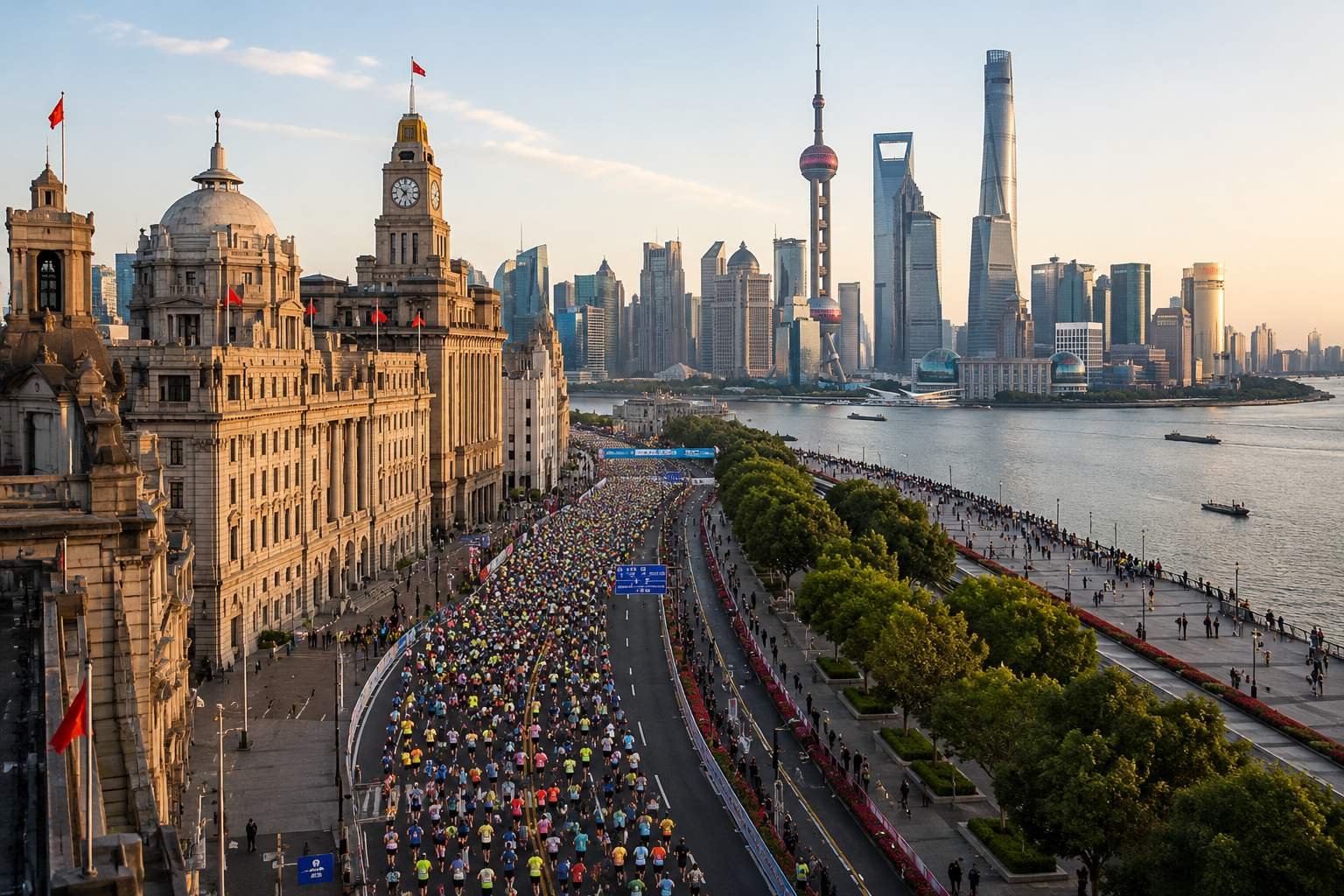
The Shanghai Marathon starts along The Bund, with the Pudong skyline — including the Oriental Pearl Tower and Shanghai Tower — visible across the Huangpu River. Image used for editorial purposes.
Why Is Everyone Watching the Shanghai Marathon Right Now?
Shanghai isn’t chasing attention with scenic coastal vistas — its case for world-class stature rests on operational scale, elite performance, and a genuine opportunity to redefine the geography of major marathon running.
One Race Away From Completing the World Marathon Majors
Shanghai replaced Chengdu as China’s candidate race for the Abbott World Marathon Majors and has been undergoing a multi-year audit. It passed Stage 1 in November 2025 with high praise from AbbottWMM leadership. In June 2026, the Sanlam Cape Town Marathon was officially confirmed as the 8th Abbott World Marathon Major, leaving Shanghai as the sole remaining candidate. The December 6, 2026 race is Shanghai’s Stage 2 final evaluation. A successful pass makes it the 9th Abbott World Marathon Major in 2027 — completing the series and activating the new Nine Star medal program for runners chasing every Major on the global calendar. For anyone at the start line on December 6, this is the race that decides whether that medal ever exists.
High Demand & Global Selectivity
China represents one of the fastest-growing running markets globally, and the Shanghai Marathon serves as its flagship event. Over 150,000 applicants routinely register for available places. With general ballot acceptance dipping to 7.2%, gaining entry to Shanghai requires lottery luck comparable to established Major marathons in Tokyo, London, and Chicago.
A World-Class PB Course
With only 25 to 30 metres of total elevation gain across 42.195 kilometers, Shanghai offers a flat layout engineered for fast running. Kenya’s Philimon Kiptoo Kipchumba set the men’s course record of 2:05:35 in 2023. At the 2025 edition, Ethiopia’s Milkesa Mengesha won the men’s race in 2:06:25, while Kenya’s Brigid Kosgei set the women’s course record of 2:16:36 — becoming the first woman to break 2:20 in Shanghai and recording the fastest women’s marathon time on Chinese soil. On the domestic front, Feng Peiyou established the national course record of 2:08:36 in 2025.
The Landmark 30th Anniversary Edition
The 2026 event represents the 30th running of the race since its 1996 debut. To commemorate the milestone, organizers launched a special logo combining the number 30 with an infinity symbol (∞) and expanded full marathon capacity from 23,000 to 30,000 runners—maximizing field size while scaling up operational infrastructure for candidate evaluation.
🔒 2026 Entry Update — Ballot Now Closed
The 2026 Shanghai Marathon general ballot has closed. All key registration dates have now passed:
- Ballot Window: April 29 – May 29, 2026 ✓ Closed
- Lottery Results: June 30, 2026 ✓ Announced
- Payment Deadline: July 20, 2026 at 12:00 PM CST ✓ Passed
If you missed the ballot, direct general entry is no longer available for this edition. Your remaining options are booking a guaranteed bib through a licensed international tour operator (Marathon Tours & Travel or Sports Tours International) — allocation at this stage is limited — or securing one of the remaining charity quota spots via the official ShangMa platform.
Already confirmed? Your entry fee (RMB 200 domestic / RMB 1,150 or $160 USD for foreign nationals) is strictly non-refundable. Head to the Expo and Race Day sections below for everything you need ahead of December 6.
What Does the Shanghai Marathon Course Look Like?
The point-to-point course links Shanghai’s historic Bund promenade with its modern downtown commercial corridors and West Bund cultural district across a flat, wide boulevard system.
The Start — Bund Bull Plaza (Km 0)
The race begins at Bund Bull Plaza along the Waitan waterfront, offering views of the Huangpu River and the Lujiazui skyscraper cluster (including Shanghai Tower, Jin Mao Tower, and Oriental Pearl Tower). Staging access opens early; runners must arrive by 5:30 AM CST to clear mandatory biometric facial recognition checkpoints. Central Huangpu District road closures take effect at 5:00 AM CST, making public transit via Metro Line 2 (Nanjing East Road Station) or Line 10 (Yuyuan Garden Station) necessary.
Nanjing Road and Historic Districts (Km 1 to 20)
Leaving the waterfront, the course turns west onto Nanjing Road Pedestrian Street before heading toward Jing’an Temple, where historic architecture contrasts with surrounding commercial towers. The route continues along Huaihai Road, winding through Xintiandi and the tree-lined avenues of the Former French Concession. Wide boulevards during the initial 15km help maintain runner spacing and steady rhythm.
The West Bund Waterfront — Longteng Avenue (Km 21.1 to 35)
After crossing the halfway point near Nanpu Bridge, the course enters Xuhui District along Longteng Avenue on the West Bund waterfront. Running parallel to the Huangpu River past the West Bund Art Center and Longhua Temple, this section features flat terrain but offers less shelter from coastal river winds. Maintaining steady pacing through this mid-race stretch is critical before turning back toward the city grid.
Longhua Road and the Finish — Xujiahui Sports Park (Km 35 to 42.195)
At kilometer 35, the route turns inland along Longhua Road through Xuhui District toward the finish line inside Xujiahui Sports Park near Shanghai Stadium. While mostly level, subtle changes in roadway grade over the final kilometers require focused effort. Post-race transit access is available at Xujiahui Station (Metro Lines 1, 3, 4, and 11).
🎯 Race-Day Pacing & Aid Station Strategy
Shanghai’s elevation profile (~25–30m total gain) supports evenly paced or slight negative-split strategies. Avoid accelerating too early through the crowded streets of Nanjing Road and Xintiandi. Save physical energy for the exposed Longteng Avenue riverfront section (km 21–35), where headwinds can affect momentum.
Hydration and aid stations are stationed every 5km along the course, alternating between water, isotonic sports drinks, salt tablets, and solid food. To assist runners in cool temperatures, the course features 6 ice stations, 8 misting/spray stations, and 16 musical performance points.
How Do You Get an Entry to the Shanghai Marathon?
While the general public lottery handles most entries, several alternative qualification and entry channels exist for competitive runners, local contributors, and international participants.
1. General Public Lottery (Domestic & Foreign)
The majority of the 30,000 full marathon spots are distributed via an open ballot on the ShangMa app and official website (`shang-ma.com`). Submission timing within the April 29 – May 29 application window does not affect draw probability. Foreign nationals registering directly pay RMB 1,150 (or $160 USD) post-selection, while domestic participants (including HK, Macao, and Taiwan) pay RMB 200.
2. Direct Entry via Speed Feeder Races
Competitive runners can bypass the public lottery by achieving top finishing placements in official regional feeder events:
- Shanghai Half Marathon: Top 200 male and top 100 female finishers
- Shanghai Women’s Half Marathon: Top 200 female finishers
- Shanghai Suzhou Creek Half Marathon: Top 150 male and top 100 female finishers
Qualifiers receive direct confirmation upon submitting performance proof and completing payment within a dedicated registration window.
3. Philanthropic Charity Quota
Runners seeking guaranteed entry without entering the lottery can secure one of 800 designated charity spots. These entries operate on a first-come, first-served basis, offering immediate confirmation upon completing the required tax-deductible philanthropic donation fee.
4. Official International Tour Packages
Overseas runners (excluding mainland China, HK, Macao, and Taiwan passport holders) can purchase guaranteed entry packages through licensed operators such as Marathon Tours & Travel and Sports Tours International. These packages typical range between **$900–$1,800 USD (€693–€1,647)** and bundle a guaranteed marathon bib with multi-day hotel accommodations, guided expo transfers, and race-morning staging logistics.
Payment Mechanics for Foreign Applicants
International payment transactions on the ShangMa platform require binding a foreign Visa or Mastercard to digital wallet applications such as **Alipay** or **WeChat Pay**. Set up and verify digital payment methods prior to the July 20 payment deadline to avoid processing errors with foreign issuing banks.
Expo Logistics & Biometric Race Pack Collection
Race pack collection takes place at the **Shanghai World Expo Exhibition & Convention Center (SWEECC)**, located at No. 850 Bocheng Road, Pudong (accessible via Metro Line 8 China Art Museum Station or Line 13 Shibo Avenue Station):
- Thursday, Dec 3, 2026: 9:30 AM – 7:30 PM (19:30) CST
- Friday, Dec 4, 2026: 9:30 AM – 7:30 PM (19:30) CST
- Saturday, Dec 5, 2026: 9:30 AM – 7:30 PM (19:30) CST
Mandatory Pickup Rules: All runners must schedule a pickup appointment time slot via the ShangMa app before visiting SWEECC. Packet pickup must be completed in person by the registered participant—proxy collection or race-morning pickup is strictly prohibited. Foreign nationals must present their original valid passport matching their registration records. At check-in, runners clear biometric facial recognition verification in accordance with China’s Personal Information Protection Law. Bibs contain single-use RFID timing chips, which must be tested at the on-site timing verification station before leaving.
Do Indian Runners Need a Visa for the Shanghai Marathon?
Yes. Mainland China does not currently offer visa-free entry, visa-on-arrival, or a standard e-visa for Indian passport holders. A physical sticker visa must be obtained in advance through official application channels.
The China L-Visa (Tourist Visa) Protocol
| Requirement | Detail |
|---|---|
| Visa type | L-Visa (Tourist), single-entry, ~30 days stay, valid for 90 days from issuance |
| Where to apply | In person at a Chinese Visa Application Service Centre (CVASC) in Delhi, Mumbai, or Kolkata |
| Passport validity | Minimum 6 months validity from intended entry date, with at least 2 blank pages |
| Document checklist | Completed application form, passport photos, round-trip flight confirmation, hotel bookings, detailed daily itinerary, 6-month bank statements, official marathon entry receipt, and cover letter |
| Biometrics | In-person fingerprint scanning at CVASC (mandatory for most applicants aged 14–70) |
| Standard fees | ₹2,900 embassy fee plus CVASC service charges (~₹1,973 regular / ~₹2,908 express processing) |
| Processing timeline | 4–10 working days; submit applications at least 3–4 weeks prior to travel |
Essential China Travel Setup
China’s commercial infrastructure is primarily cashless. Download and link an international credit card to Alipay or WeChat Pay prior to departure from India. Paper arrival cards are supplemented by a Digital Arrival Card system accessible online or via WeChat mini-programs up to 6 days before entry. Because standard foreign web services (Google Maps, Gmail) face regional access restrictions in mainland China, setting up an active international roaming package or an authorized VPN prior to arrival helps maintain access to routine mapping and communication tools.
Flight Connections to Shanghai
International travelers land at Shanghai Pudong International Airport (PVG), located 30km east of the city center. Flights from Indian hubs (Delhi, Mumbai, Bengaluru) route through regional transit points such as Bangkok, Singapore, Kuala Lumpur, or Dubai. Allow adequate travel buffer days prior to Thursday’s Expo opening.
What’s the Weather Like in Shanghai for the Marathon?
Early December brings cool, dry autumn weather to Shanghai. Average race-morning conditions feature temperatures around 8.5°C (47°F), rising to 12–14°C (54–57°F) by midday, accompanied by relative humidity levels near 78%. Early mornings at Bund Bull Plaza can feel crisp due to river breeze; lightweight discardable layers or arm sleeves are recommended for start-corral staging prior to the 7:00 AM gun start.
How Does Shanghai Compare to Other World Marathon Majors and Asian Races?
| Race | Timing | Status | Entry Method | Best For |
|---|---|---|---|---|
| Shanghai Marathon | Early December | Platinum Label · Sole remaining AbbottWMM candidate · Stage 2 evaluation Dec 6, 2026 | 2026 ballot closed · Tour Operators, Charity spots (limited) | Flat PB course, running the race that decides the Nine Star medal program |
| Tokyo Marathon | Early March | Abbott World Marathon Major | Public Ballot, Charity, Tour Operators | Established Asian Major with world-class organization |
| Cape Town Marathon | Mid-October | Confirmed 8th Abbott World Marathon Major — officially joins the series in 2027 | Ballot, International Direct Entry | Africa’s inaugural Major, coastal views, Boston Qualifier |
| Sydney Marathon | Late August | 7th Abbott World Marathon Major | Ballot, Time Qualification, Travel Packages | Iconic finish line at Sydney Opera House |
| Beijing Marathon | Late October / Nov | World Athletics Gold Label | Public Ballot | Historic national marathon starting at Tiananmen Square |
🏆 Bottom Line — FatMarathoner Verdict
Should You Run the Shanghai Marathon 2026?
For runners seeking a high-caliber urban race with personal best potential, the Shanghai Marathon offers an exceptional experience. With an elevation gain of ~25–30m, deep elite fields, and smooth organization, it ranks among Asia’s top road races. The 2026 ballot is closed and confirmed runners are now in race prep mode — but if you’re still looking to get in, limited options remain. Either way, December 6 is the most consequential day in marathon running this year: the race that decides whether the Nine Star medal program becomes reality.
- Already confirmed? Sort your visa now: Apply for a Chinese L-Visa at a CVASC center in Delhi, Mumbai or Kolkata well ahead of race week — processing takes 4–10 working days and the window is tighter than it looks.
- Set up digital payments before you fly: Link your Visa or Mastercard to Alipay or WeChat Pay before leaving India — you’ll need it for everything from transit to race-day snacks, and foreign cards alone won’t cut it.
- Missed the ballot? Tour operators are your best remaining shot: Licensed packages through Marathon Tours & Travel and Sports Tours International bundle a guaranteed bib with hotel and expo transfers — allocation is limited at this stage so move quickly.
- Planning for 2027? Set your reminder now: If Shanghai passes its December 6 evaluation, lottery demand for 2027 will surge sharply — the ballot window opens late April, and being first in line matters when acceptance rates sit at 7.2%.