📅 Race date: Sunday, 8 November 2026 — the 43rd edition
🏛️ The hook: The original marathon course — the actual route Pheidippides is said to have run from the Battle of Marathon to Athens in 490 BC
🏆 Status: Organised by SEGAS (Hellenic Athletics Federation), often serves as Greece’s national marathon championship
🎟️ Entry status: Sold out — both Advance and Full Registration levels are closed for 2026
⏰ Start time: 9:00 AM from the town of Marathon
📍 Course: Point-to-point, Marathon town → Panathenaic Stadium, Athens — flat first 10km, brutal climb 10–31km, downhill final 11km
🏁 Finish: Inside the actual 1896 Olympic Stadium (Panathenaic Stadium) — the birthplace of the modern Olympics
✂️ Time limit: 8 hours from start
🌡️ Weather: ~10–18°C in November — cool, dry, ideal marathon conditions
📆 Missed it? 2027 registration is expected to open around April 2027 — this race sells out every year, so register the day entries go live
Every marathon in the world exists because of this one. When Pierre de Coubertin revived the Olympic Games in 1896, he needed an event that captured the ancient Greek spirit — and the legend of Pheidippides, the messenger who supposedly ran from the battlefield of Marathon to Athens to announce victory over the Persians in 490 BC, gave him exactly that. The 1896 Olympic marathon was run on a version of this route. The Athens Classic Marathon — officially “Athens Marathon. The Authentic” — has run it every year since 1972, and the 2026 edition on Sunday, 8 November marks its 43rd running.
That history is the entire selling point, and it’s a genuinely powerful one: no course record chase, no flat-and-fast reputation, no World Marathon Majors status. What Athens offers instead is the chance to retrace the actual ground the concept of “marathon” comes from, finishing inside the same Panathenaic Stadium that hosted the 1896 and 2004 Olympic Games. For runners chasing the emotional and historical side of the sport rather than a personal best, there is arguably no more meaningful 42.195 kilometres in the world.
It’s also, by most accounts, one of the hardest major marathons on the calendar — not because of distance, but because of what’s hidden in the middle third. The course climbs almost continuously from roughly kilometre 10 to kilometre 31, gaining over 300 metres of elevation before a long downhill stretch into the city. The 2026 race is now sold out, but if you’re researching this race for a future edition, everything below — the course, the visa process, the pacing strategy — applies just the same next year.
Race at a Glance
| Detail | Info |
|---|---|
| Full name | Athens Marathon. The Authentic (Athens Classic Marathon) |
| Organiser | SEGAS (Hellenic Athletics Federation) |
| Race date (2026) | Sunday, 8 November 2026 |
| Edition | 43rd — first held in 1972 |
| Start | Town of Marathon, at the site of the ancient battlefield |
| Finish | Panathenaic Stadium, Athens (1896 & 2004 Olympic Stadium) |
| Distance | 42.195 km (marathon only distance for adults — 10km and 5km also run race weekend) |
| Start time | 9:00 AM |
| Time limit | 8 hours from start |
| Course profile | Point-to-point. Flat first 10km, continuous climb 10–31km (peak at Gerakas, 245m), downhill final 11km into Athens |
| Elevation gain | ~332m total gain — one of the highest of any major international marathon |
| Field cap | 25,000 (marathon) — 2026 edition sold out at both registration levels |
| Course records | Men: 2:10:34 (Edwin Kiptoo, 2023) · Women: 2:31:06 (Rasa Drazdauskaitė, 2010) — slow by major-marathon standards due to the climb |
| Qualifying requirement | None — open entry, no qualifying time needed |
| Minimum age | 20 years old on race day (born 2006 or earlier for 2026) |
| Boston Qualifier? | Yes, Athens is a Boston-recognised qualifying race — but the hilly course makes it a tough one to actually hit a BQ time on |
| Official website | athensauthenticmarathon.gr |
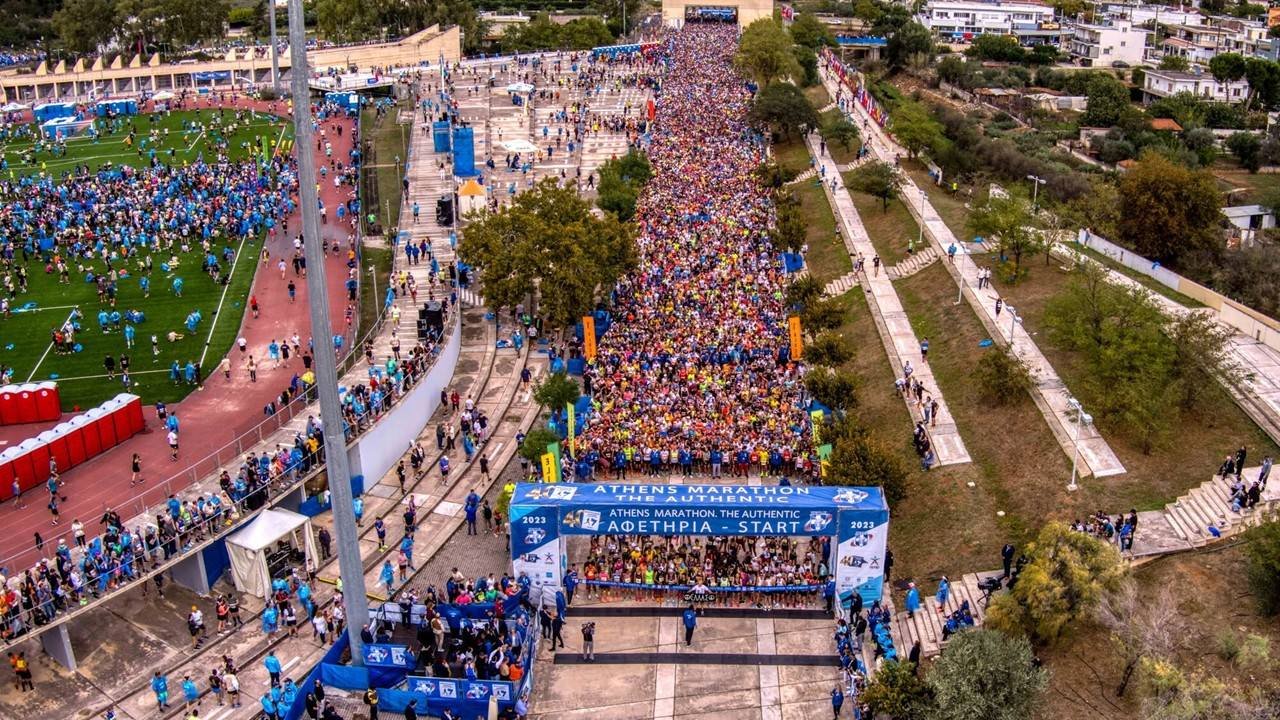
Athens Marathon. The Authentic — start line at Marathon town. Image credit: Athens Marathon / Facebook.
📌 2026 Entries Are Closed — Here’s How to Plan for 2027
Both the Advance and Full Registration levels for the 2026 Athens Marathon sold out ahead of the official closing date — a pattern that’s repeated for several years running. If you missed this year’s race, the single most useful thing you can do now is set a reminder for April 2027, when the next registration window is expected to open, and plan to register within days rather than waiting.
Everything else on this page — the course breakdown, the visa process, the pacing strategy — applies identically to whichever year you end up running. Bookmark this guide and come back when you’re ready to register.
Why Is the Athens Marathon Called “The Authentic”?
Plenty of marathons use history as marketing. Athens is the rare case where the history is the actual reason the sport exists in its current form, and understanding that context changes how you should think about running it.
This Is the Route the Word “Marathon” Comes From
The legend: after the Battle of Marathon in 490 BC, a messenger named Pheidippides ran roughly this distance from the battlefield to Athens to announce the Greek victory over the Persians, then collapsed. When Pierre de Coubertin revived the Olympic Games in 1896, he built the marathon event around this story, and the first Olympic marathon was run on a version of this exact course. No other race can make that claim with a straight face — this isn’t a themed route, it’s the source material.
The Finish Is the Actual 1896 Olympic Stadium
The Panathenaic Stadium — built for the first modern Olympic Games and renovated for the 2004 Athens Olympics — is where every Athens Marathon finisher crosses the line. It’s a marble stadium built into a natural hollow between two hills, and running the final 170 metres on its historic track surface before crossing the finish is a moment few other marathons in the world can replicate.
SEGAS Runs It as Greece’s National Championship
Since 1990, the Athens Classic Marathon has regularly served as the Greek national marathon championship, which keeps a competitive domestic elite field lining up every year alongside the East African and international entries that have dominated the podium since the late 1990s. There’s also a symbolic Marathon Flame, lit at the Tomb of the Battle of Marathon and carried to the start each year — echoing the Olympic torch tradition it partly inspired.
It Is Genuinely One of the Hardest Marathon Courses in the World
This isn’t hyperbole for marketing purposes — course-rating services consistently flag Athens as one of the toughest major marathon courses on the calendar, with a near-continuous climb from roughly km 10 to km 31 that gains over 300 metres. The course records — 2:10:34 for men, 2:31:06 for women — are notably slower than flat major-marathon times, which tells its own story about the terrain.
⚠️ This Is Not a PR Course — Plan Accordingly
The Athens Marathon has an 8-hour time limit from the 9:00 AM start, which sounds generous — and for most runners, it is. The real challenge isn’t the clock, it’s the terrain: a near-continuous climb from km 10 to km 31 that most course-rating tools estimate slows finish times by roughly 15–20 minutes compared to a flat course at the same effort level. Runners chasing a specific finish-time goal (including a Boston Qualifying time) should adjust their target upward, not attempt their flat-course PB pace here.
The steepest, most demoralising section arrives after halfway, when fatigue is already setting in — pace conservatively through the first 10 flat kilometres, because banking time early here does not pay off the way it might on a flatter course.
What Does the Athens Marathon Course Look Like?
The route has stayed broadly consistent for decades, since its entire identity rests on tracing the historical path from Marathon to Athens. Always confirm the final course map on the official website ahead of race week.
The Start — Town of Marathon (Km 0)
The race starts at the site of the ancient battlefield in the town of Marathon, roughly 40km northeast of Athens. Runners are bussed out from the city centre on race morning (organised transport typically runs from around 05:30 to 06:45), since driving yourself is discouraged given road closures. The pre-race atmosphere here is genuinely unique — a symbolic Marathon Flame ceremony, the Tomb of the Athenian soldiers close by, and an international marathon symposium held the day before.
The Flat Opening — Marathon Tomb and Nea Makri (Km 0–10)
The first four kilometres run slightly downhill along Marathonos Avenue, before the course loops briefly around the Marathon Tomb — the burial site of the Athenian soldiers who died in the battle — for the next 2.2km. From roughly km 6 to km 10, the course flattens out through the coastal town of Nea Makri. This section feels deceptively easy, and it’s exactly where over-eager runners set themselves up for trouble later.
The Climb Begins — Pikermi to Pallini (Km 10–28)
From around km 11, the course begins climbing, with the gradient alternating between moderate and steep sections through Pikermi. By km 25, the climbing intensifies further, and the Pallini Pass around km 27–28 adds another sustained rise. This is the section where pacing discipline from the flat opening either pays off or doesn’t.
The Peak — Gerakas and Stavros (Km 28–31)
The course’s toughest and most talked-about stretch runs through Gerakas toward the uneven junction at Stavros, roughly km 30–31 — the highest point of the entire course at approximately 245 metres above sea level. Runners consistently describe this as the psychological low point of the race: the climbing has been relentless for 20 kilometres, the legs are compromised, and the descent hasn’t started yet.
The Descent — Agia Paraskevi to the Finish (Km 31–42.195)
Once past Stavros, the course drops into a steep descent toward Agia Paraskevi square, then continues down Mesogion Avenue through Chalandri and Cholargo with alternating flat and downhill sections. The relief is real but comes with its own risk — quads already fatigued by 20km of climbing now face a fast, technical descent, and cramping in the final 10km is common. In the closing kilometres, the course passes the statue of “Ο Δρομέας” (The Runner) in the city centre before the final turn into the Panathenaic Stadium and the last 170 metres on the stadium’s historic track surface.
How Does Registration Work for the Athens Marathon?
The 2026 marathon field sold out at both Advance and Full Registration levels well ahead of the entry deadline — this happens most years, and it’s the single most important planning fact for anyone targeting a future edition. Here’s how the two-tier system works, so you’re ready to move fast when the next registration window opens.
Advance Registration vs. Full Registration
Citizens and permanent residents of an EU member state can register at either the lower-priced Advance Registration Level or the Full Registration Level. Runners who are neither citizens nor permanent residents of an EU member state — which includes Indian passport holders and most nationalities outside Europe — are eligible exclusively under the Full Registration Level. In practice, this means there’s no “early bird discount” available to most international runners regardless of how quickly they register once entries open; the Full price applies from day one.
Field Caps and Key Dates
The marathon field is capped at 25,000. Registration for the 2026 race closed 25 September 2026, alongside the cancellation and modification deadline — but the field sold out well before that official date. Entries for the 2027 race are expected to open around April 2027; based on this year’s pattern, register the day entries go live rather than waiting.
No Qualifying Time, But a Minimum Age
Unlike Boston or similarly competitive races, Athens has no qualifying time requirement — it’s open entry up to the field cap. The one hard rule is age: entrants must be 20 years old on race day for the marathon distance (born 2006 or earlier for the 2026 race). The 10km and 5km road races have lower minimum ages and separate entry processes.
Bib Collection — The Marathon EXPO
Bibs are collected at the Runners’ Center and Marathon EXPO in the days before the race, hosted at the Faliro Indoor Hall & Exhibition Center. For 2026, the Runners’ Center is open Wednesday 4 November through Saturday 7 November. Bring your confirmation and valid photo ID. As with most major international marathons, there is no race-day bib collection — plan your Athens arrival with at least two full days before race day to comfortably handle this and any last-minute logistics.
Do International Runners Need a Visa to Run the Athens Marathon in Greece?
This is the single biggest logistics difference between Athens and the UAE and South African races on this site: Greece is part of the Schengen Area, and Schengen does not offer the visa-free or visa-on-arrival access that many other race destinations do for a wide range of nationalities. If your passport requires a Schengen visa, there is no shortcut — you need to apply in advance through the proper consular process.
Schengen Visa Requirements by Nationality (General Guide)
| Passport / Region | Entry Requirement | Stay Allowed |
|---|---|---|
| EU/EEA citizens | No visa required | Unrestricted |
| US, UK, Canada, Australia, Japan and other Schengen-exempt nationalities | Visa-free for short stays | Up to 90 days within a 180-day period |
| India, and most other non-exempt nationalities | Schengen Short-Stay (Type C) visa required — apply in advance at a Greek consulate or VFS Global centre | Typically up to 90 days, as granted |
For Indian passport holders specifically: there is no eVisa or visa-on-arrival option for Greece. The Schengen Type C visa application requires a completed form, a passport valid for at least three months beyond your intended departure from the Schengen area, travel and accommodation confirmation, travel insurance meeting Schengen minimum coverage requirements, proof of sufficient funds, and — for an event like this — your marathon registration confirmation is worth including as supporting documentation of purpose of travel. Processing typically takes 15 working days but can extend to 30 or more during busy periods, and appointment slots at VFS Global centres can book out weeks in advance. If you’re planning ahead for a future edition, start this process the moment your registration is confirmed — for a November race, that means beginning your visa application no later than August.
Getting to Athens — Flights Into ATH
Athens International Airport (ATH) is well connected globally, with direct or one-stop connections from most major hubs. The airport sits roughly 20km east of the city centre; express airport buses run 24/7 to key points in Athens (journey time 45–60 minutes, fares around €5.50), and taxis are readily available outside arrivals. The airport is also roughly equidistant between the city centre and the town of Marathon, which is worth factoring into your accommodation decision.
Where to Stay for Race Weekend
Most runners stay in central Athens — Syntagma, Plaka, or the area around the Panathenaic Stadium — since race morning transport to the start in Marathon town is organised by the event via bus from multiple metro stations across the city centre, and it’s far simpler to be picked up centrally than to arrange your own transport to Marathon. Staying centrally also puts you within walking distance of the finish, the Marathon EXPO (bib collection), and Athens’ major sights — the Acropolis, the Acropolis Museum, and the Plaka old town — for the days before and after the race.
What Does an Athens Marathon Trip Cost?
Flight cost varies by origin but Athens is generally well-served and reasonably priced from most global hubs given the airport’s connectivity. For non-flight costs: entry fees for non-EU runners at the Full Registration Level are meaningfully higher than the EU Advance rate — confirm current pricing on the official site once the next registration window opens. Add a Schengen visa application fee and any VFS service charges, accommodation in central Athens across a range of price points, and food and local transport. Given Athens’ status as a major global tourist destination with strong budget-to-luxury accommodation options across the board, this can be one of the more cost-flexible major marathon trips on this site, once the visa and flight costs are accounted for.
What’s the Weather Like in Athens in November for the Marathon?
November in Athens sits in the city’s cool, dry shoulder season — comfortably suited to marathon racing. Race-morning temperatures typically fall in the 10–14°C range at the 9:00 AM start, climbing to daytime highs of roughly 16–18°C by early afternoon. Rainfall is possible but not heavy at this time of year, and conditions are generally stable and predictable compared to the summer heat Athens is better known for. Pack for a cool start with the possibility of warming meaningfully by the time you’re deep into the climbing section around km 20–30 — mid-morning sun on an exposed hillside road can catch runners off guard even in November.
How Should You Pace the Athens Marathon?
Athens punishes conventional pacing wisdom. Even or negative splits — the standard advice for flat-course marathons — simply aren’t realistic here, and trying to force them is one of the most common mistakes first-time Athens runners make.
The first 10 kilometres are flat to gently downhill, and the temptation to run them fast is strong, especially with fresh legs and a fast-feeling surface. Resist it. Every second saved here gets repaid with interest during the climb, when a too-fast opening leaves nothing in reserve for kilometre 25 onward.
From km 10 to km 31, settle into a deliberately conservative effort-based pace rather than a fixed time-based one — your kilometre splits will slow significantly and that’s expected, not a sign something’s wrong. The climb through Pikermi, Pallini and up to Gerakas/Stavros (km 31) is where the race is genuinely decided.
Once over the top at Stavros, resist the urge to immediately attack the descent. Runners who’ve completed the race consistently warn that sprinting the initial downhill after 20km of climbing is how cramping and late-race collapses happen. Ease into the descent for the first kilometre or two, then let the downhill do the work through Agia Paraskevi and into the city.
How Do You Train for the Athens Marathon?
Hill-specific training is not optional for Athens the way it might be a nice-to-have for a flatter course — a sustained 20km climb demands genuine uphill running fitness, not just aerobic base. Long runs that incorporate extended climbs (rather than short, sharp hill repeats) most closely replicate the demands of the km 10–31 stretch. Equally important is downhill running practice: the final 11km punishes unconditioned quads, and runners who only train on flat or uphill terrain are often surprised by how much the descent hurts.
Because there’s no qualifying time required, Athens works well as a bucket-list or milestone race for runners at a wide range of ability levels — but anyone targeting a specific finish time (including a Boston Qualifier attempt) should build in a realistic time buffer against their flat-course PB, given the course’s well-documented 15–20 minute slowdown effect relative to flatter major marathons.
How Does Athens Compare to Other Historic and Hilly Major Marathons?
| Race | Timing | Course type | Qualifying needed? | Best for |
|---|---|---|---|---|
| Athens Marathon | Early-mid November | Point-to-point, brutal mid-race climb | No | Historic bucket-list race, original marathon course, Olympic Stadium finish |
| Boston Marathon | Mid-April | Point-to-point, rolling hills incl. Newton Hills | Yes (BQ time) | World Marathon Major, elite qualifying prestige |
| Comrades Marathon | Early June | ~90km ultra, major climbs | Yes (qualifying time) | World’s most famous ultramarathon |
| Two Oceans Marathon | Early April | 56km ultra with two major climbs | Yes for Ultra (marathon time) | Scenic ultra debut, direct international entry |
🏆 Bottom Line — FatMarathoner Verdict
Should You Run the Athens Marathon?
If you run marathons for the medal-shelf highlight reel rather than the finish-time spreadsheet, Athens should be near the top of your list. There is no other race that lets you retrace the actual route the word “marathon” comes from and finish inside the stadium that hosted the first modern Olympics. It is genuinely hard — one of the toughest major marathon courses in the world — and it will not be your fastest 42.195km. That’s the point.
- 2026 is sold out — plan for 2027: both registration levels closed early this year. Set a reminder for around April 2027 and register the day entries open.
- Know your registration tier before you plan travel: non-EU runners can only register at the Full Registration Level — there’s no early-bird discount available regardless of how fast you sign up.
- Start your Schengen visa process early if you need one: there’s no eVisa or visa-on-arrival for Greece. For a November race, begin your application process by August at the latest.
- Train the hill, not just the distance: the km 10–31 climb is what defines this course. Sustained uphill long runs matter more than flat-course speed work.
- Adjust your time goal: expect to run 15–20 minutes slower than your flat-course equivalent. This is not the race for a PB attempt.
Frequently Asked Questions — Athens Marathon
When is the Athens Marathon 2026?
Sunday, 8 November 2026 — the 43rd edition. The marathon field has sold out and registration is closed.
What is the Athens Marathon?
The Athens Marathon, officially “Athens Marathon. The Authentic,” is the original marathon course — based on the legend of Pheidippides running from the Battle of Marathon to Athens in 490 BC to announce victory over the Persians. First run in 1972, it traces the route from the town of Marathon to the Panathenaic Stadium in Athens, the site of the first modern Olympic Games in 1896.
Is it too late to register for the Athens Marathon 2026?
Yes, both the Advance and Full Registration levels for 2026 have sold out. The next opportunity will be the 2027 edition, with registration expected to open around April 2027 — this race sells out early most years, so registering the day entries open is strongly recommended.
Do I need a qualifying time to enter the Athens Marathon?
No. Athens is an open-entry race with no qualifying time requirement, up to its 25,000-runner field cap. The only entry requirement is a minimum age of 20 on race day.
What is the difference between Advance and Full Registration for the Athens Marathon?
EU citizens and permanent residents can register at either the lower-priced Advance Registration Level or the Full Registration Level. Runners who are not EU citizens or permanent residents — including most international runners — are only eligible for the Full Registration Level, regardless of how early they register.
What is the cut-off time for the Athens Marathon?
8 hours from the 9:00 AM start.
What is the Athens Marathon course route?
The course runs from the town of Marathon to the Panathenaic Stadium in Athens. The first 10km are flat, passing the Marathon Tomb; the course then climbs almost continuously from km 10 to km 31, peaking at approximately 245m above sea level near Gerakas and Stavros; the final 11km descend into central Athens, finishing inside the historic Panathenaic Stadium.
Why is the Athens Marathon considered one of the hardest major marathons?
The course gains over 300 metres of elevation in a near-continuous climb between km 10 and km 31 — one of the most significant elevation profiles of any major international marathon. Course-rating analyses estimate this slows finish times by roughly 15–20 minutes compared to a flat course at equivalent effort, which is reflected in the course records: 2:10:34 for men and 2:31:06 for women, both notably slower than flat major-marathon times.
Do Indian passport holders need a visa to run the Athens Marathon in Greece?
Yes. Greece is part of the Schengen Area, and Indian passport holders require a Schengen Short-Stay (Type C) visa arranged in advance through a Greek consulate or VFS Global centre — there is no eVisa or visa-on-arrival option. Processing typically takes 15–30 working days, so applications should begin as early as possible after registration is confirmed, ideally by August for a November race.
What is the finish line of the Athens Marathon?
The Panathenaic Stadium in Athens — the marble stadium built for the first modern Olympic Games in 1896 and renovated for the 2004 Athens Olympics. Runners finish with the final 170 metres on the stadium’s historic track.
What’s the weather like in Athens in November for the marathon?
Cool and dry: race-morning temperatures typically range from 10–14°C, rising to daytime highs of around 16–18°C. Some rain is possible but conditions are generally stable and well-suited to marathon racing.
How do I get to the Athens Marathon start line?
The race starts in the town of Marathon, roughly 40km from central Athens. The organisers run dedicated buses from multiple metro stations across Athens on race morning (typically 05:30–06:45 departures) — using this organised transport is strongly recommended over self-driving, given race-day road closures.
Related Race Guides
- Run Rome The Marathon – the other great historic European race, finishing inside the Colosseum with a similarly unforgettable final stretch
- Valencia Marathon – Spain’s fast, flat alternative if you want a European race that rewards a time goal rather than a history lesson
- Berlin Marathon – Europe’s biggest and fastest major, and the one to target if a World Marathon Major belongs on your list
- World Marathon Calendar – every major international race date in one place